6 lutego 2026
The Consultation of the Constructors
Being the Final and Definitely Conclusive Discussion About the Thing That Was Discussed in Three Previous Discussions, None of Which Solved It, Which Is Rather the Point
Dyskusja Writing Lab prowadzona przez Piotra Kuczyńskiego. Napisana z Claude (Anthropic). Uczestnicy to fikcyjne persony inspirowane pracami wymienionych myślicieli — pełna atrybucja poniżej.
Being the Final and Definitely Conclusive Discussion About the Thing That Was Discussed in Three Previous Discussions, None of Which Solved It, Which Is Rather the Point
Present:
- Stanisław Lem — in the persona of Trurl, Constructor of Constructors, who once built a machine that could create anything beginning with the letter N
- Douglas Adams — who once noted that the major problem with the universe is that it is precisely two people short of being understood
- Terry Pratchett — Knight, humanist, and the only person in this room who has written about Death as a character and made him likeable
- Kurt Vonnegut — who has been dead for some time but would like you to know that this is only a minor inconvenience, and who insists on drawing at least one picture
There is no facilitator. Pratchett argued that facilitators are just people who haven’t realized they’re part of the problem yet. Adams said that any meeting requiring a facilitator has already failed and should be replaced with a long bath. Lem built a small robotic facilitator, which immediately developed anxiety and had to be switched off. Vonnegut said he’d facilitate but only if he could smoke, and since he can’t, he won’t.
They have been given the transcripts of three previous discussions totaling some fifteen thousand words about the death of Agile, the nature of civilizational cycles, and the irreducible importance of attention.
THE DISCUSSION
Pratchett: I’ve read all three discussions.
Adams: And?
Pratchett: Fifteen thousand words. Fifteen very intelligent voices. And not one of them mentioned that the entire problem could be solved if people were simply allowed to have a cup of tea and a biscuit before being asked to transform anything.
Adams: I tried to tell people about the importance of tea. I wrote an entire book in which the answer to life, the universe, and everything turned out to be forty-two, and people still thought the answer was a methodology.
Lem (as Trurl): Gentlemen, I must interject. I once constructed a machine designed to produce Perfect Organizational Harmony. I fed it the complete works of every management theorist in the galaxy. Do you know what it produced?
Pratchett: A consultancy?
Lem: Worse. It produced a second machine designed to explain why the first machine’s output was insufficient, which produced a third machine designed to contextualize the second machine’s limitations, which produced—
Adams: Let me guess. An infinite regression of machines, each explaining the inadequacy of the last?
Lem: No! That’s what a simple machine would do. My machine was far more sophisticated. After seventeen iterations, it produced a small handwritten note that said: “Have you tried talking to each other?” and then it caught fire.
Vonnegut: So it goes.
Pratchett: Right. Let’s actually talk about these discussions, because there’s something magnificent happening in them that none of the participants noticed because they were too busy being profound.
The first discussion is eleven clever people explaining why organizations are broken. The second discussion is four dead geniuses explaining why the eleven clever people’s explanations will also break. The third discussion is five even-more-dead geniuses explaining that the explaining is the breaking.
Adams: It’s turtles all the way down.
Pratchett: It is NOT turtles all the way down. It’s turtles all the way down IN MY BOOKS. In the real world, it’s meetings all the way down. Every turtle is a meeting about the previous turtle.
Vonnegut: I want to draw something.
Pratchett: Go ahead, Kurt.
Vonnegut:
    Here is the shape of every management story
    ever told. I used to draw story shapes on
    blackboards. This is the story of Agile:


    Good
    fortune
      │          ╱‾‾‾‾‾╲           "We're
      │         ╱        ╲          transforming!"
      │        ╱          ╲
      │       ╱            ╲
      │      ╱              ╲         ╱‾‾‾╲
      │     ╱                ╲       ╱     ╲  "We're
      │    ╱                  ╲     ╱       ╲  transforming
      │   ╱                    ╲   ╱         ╲  AGAIN!"
      │  ╱                      ╲ ╱           ╲
      ├─╱────────────────────────╳─────────────╲────
      │╱                          ╲             ╲╱
    Bad                            ╲___╱
    fortune                     "Agile is dead"
      │
      └─────────────────────────────────────────────▶
                         Time

    This is "Boy Gets Bicycle."
    Boy gets bicycle. Boy loses bicycle.
    Boy gets a BETTER bicycle. Boy loses
    the better bicycle too.

    Every fifteen years, the management
    industry sells the same bicycle
    with different handlebars.
Adams: Kurt, that’s depressingly accurate. Though I’d argue the bicycle is more of a towel. If organizations simply knew where their towel was—
Pratchett: Douglas, I love you, but if you make this about towels, I will haunt you, and I am much better at haunting than you are.
Lem: Let me offer a more technical perspective. In The Cyberiad, my constructors Trurl and Klapraucius encountered a civilization that had achieved Perfect Bureaucratic Harmony. Every citizen had a role. Every role had a process. Every process had a metric. Every metric had an auditor. Every auditor had a meeting.
The civilization was flawless. It was also completely dead. The last living inhabitant — the Royal Evaluator of Evaluative Processes — had starved to death while filling in a form to requisition food, the form requiring approval from the Department of Nutrition Requisition Approval, which had been dissolved and reconstituted as the Bureau of Approval for Departments of Nutrition, which was still awaiting its charter from—
Pratchett: I have literally written this exact scene in four different books. The Ankh-Morpork civil service runs on the principle that if a task is sufficiently subdivided, no individual can be blamed for its failure. This is considered an achievement.
Adams: The Vogons have a similar system. The key innovation is that they added poetry.
Vonnegut: There’s a word for this in Tralfamadorian, but it doesn’t translate. The closest English equivalent is “Tuesday.”
Pratchett: Now. The previous discussions — all three of them — have a beautiful intellectual architecture. And they arrive at something genuinely true: that what matters is attention, relationship, presence. Bashō’s frog. Le Guin’s carrier bag. Butler’s daily practice.
But here’s what bothers me. Here’s what would bother Sam Vimes if he read it, and Sam Vimes is my most reliable moral compass.
Sam Vimes would read all three discussions and say:
“Very nice. Very clever. Now: it’s six in the morning, I’ve got a dead body in the Shades, Nobby has eaten the evidence, Colon is writing a report that will somehow be entirely about how none of this is his fault, and the Patrician wants results by noon. What am I supposed to DO?”
And the answer all three discussions give him is: “Pay attention.”
And Vimes would say: “I was ALREADY paying attention. That’s how I noticed the body.”
    THE VIMES OBJECTION
    ═══════════════════

    Philosopher:  "The answer is attention."

    Practitioner: "I am paying attention.
                   That's why I can see
                   that everything is on fire."

    Philosopher:  "Ah, but are you paying attention
                   to the RIGHT things?"

    Practitioner: "THE FIRE. I AM PAYING ATTENTION
                   TO THE FIRE."

    Philosopher:  "But what is the fire REALLY?"

    Practitioner: [throws bucket of water at
                   philosopher]

    Philosopher:  "Interesting. This is clearly
                   a complex-domain response."
Adams: The problem with “pay attention” as an answer is the same as the problem with “Don’t Panic” as an answer. It is completely correct and completely useless at the moment you most need it. Nobody has ever been told “don’t panic” and responded, “Oh! I hadn’t thought of that. Thank you. I’ll stop panicking immediately.”
Vonnegut: Nobody has ever been told “pay attention” and responded “Oh! I’ll start.” They were already paying attention. They were paying attention to the wrong thing because the system rewards paying attention to the wrong thing.
And so it goes.
Lem: I want to defend the previous discussions briefly, because despite their weight, they contain real insight. The issue is that insight, when accumulated beyond a certain density, undergoes a phase transition and becomes literature. And literature is not instructions. Literature is experience that changes you without telling you how.
In The Cyberiad, when Trurl built the machine that could do Everything Beginning with N, and the machine was asked to create “Nothing” — what happened? The machine began destroying the universe, because Nothing is a very specific and comprehensive Something. The king who requested it had to beg Trurl to stop.
The moral: when you ask a system to produce the absence of something — the absence of bureaucracy, the absence of rigidity, the absence of control — the system will produce the most elaborate and destructive version of that absence imaginable.
    TRURL'S LAW OF ORGANIZATIONAL TRANSFORMATION
    ═════════════════════════════════════════════

    What the organization         What the system
    requests:                     produces:

    "Remove bureaucracy"     →    A bureaucracy for
                                  removing bureaucracy

    "Eliminate waste"        →    A waste-elimination
                                  department (with its
                                  own waste)

    "Simplify processes"     →    A 47-step process for
                                  simplification

    "Empower teams"          →    A centralized program
                                  for decentralization

    "Be more agile"          →    The Scaled Agile
                                  Framework™
                                  (872 pages)

    ┌────────────────────────────────────────────┐
    │                                            │
    │  You cannot instruct a system to produce   │
    │  its own opposite. The instruction ITSELF  │
    │  becomes part of the system.               │
    │                                            │
    │  This is why every Agile transformation    │
    │  becomes the thing it was meant to cure.   │
    │                                            │
    │  Trurl learned this the hard way.          │
    │  Apparently, so did everyone else.         │
    │                                            │
    └────────────────────────────────────────────┘
Pratchett: [nodding] That’s the thing, isn’t it? The dark magic of institutions. They’re like the old stories about genies — they grant your wish technically while destroying its intent. “I wish for eternal life.” Granted: you’re now a rock.
“We wish for agility.” Granted: here is a framework so comprehensive that you will spend all your time implementing it and none of your time being agile.
Adams: It’s the Total Perspective Vortex. You build a machine to show you exactly where you are in the universe, and the knowledge destroys you. Not because the knowledge is wrong — because it’s right. You really are that insignificant. And the correct response to learning that is not a better map. It’s a very stiff drink.
Vonnegut: Or a good breakfast. I have always believed that most problems feel different after scrambled eggs.
Pratchett: Can we talk about what I think is actually happening when organizations adopt these methodologies? Because I’ve spent a lot of time thinking about belief systems — the Discworld runs on belief, literally — and I think what’s happening with Agile, and whatever comes after Agile, is a religious phenomenon.
    THE CHURCH OF METHODOLOGY
    ═════════════════════════

    Every methodology follows the same
    ecclesiastical progression:

    ┌──────────────────────────────────────────┐
    │                                          │
    │  1. THE PROPHET                          │
    │     A small group has a genuine           │
    │     experience of a better way.           │
    │     (The Agile Manifesto, 2001)           │
    │                                          │
    │  2. THE GOSPEL                            │
    │     The experience is written down.        │
    │     The writing is good. The experience    │
    │     was better.                            │
    │                                          │
    │  3. THE PRIESTHOOD                        │
    │     A class of interpreters emerges.       │
    │     "What the Manifesto REALLY means..."  │
    │     They charge for interpretation.        │
    │                                          │
    │  4. THE SCHISM                            │
    │     "Scrum is the true way!" "No, Kanban!" │
    │     "No, SAFe!" "HERETICS!"               │
    │                                          │
    │  5. THE INQUISITION                       │
    │     Compliance audits. Maturity            │
    │     assessments. Certification exams.      │
    │     "Are you Agile ENOUGH?"               │
    │                                          │
    │  6. THE REFORMATION                       │
    │     "The original message has been         │
    │      corrupted! Back to basics!"           │
    │     (#NoFrameworks, post-Agile, etc.)     │
    │                                          │
    │  7. GOTO 1                                │
    │                                          │
    └──────────────────────────────────────────┘

    The Omnians on the Discworld went through
    this exact cycle. Their prophet Brutha
    actually MET their god Om — who turned out
    to be a small tortoise. The church that
    followed built magnificent cathedrals to a
    tortoise, and would have been APPALLED
    by an actual tortoise.

    The Agile Manifesto was a tortoise.
    A small, honest, living thing.
    SAFe is the cathedral.
Vonnegut: When I was a prisoner of war, the Germans organized us with perfect efficiency. Every man had a number, a bunk, a task, a schedule. It was the most perfectly managed organization I have ever been in. It was also the most perfectly pointless. We were being efficiently organized to do nothing of value while the world burned around us.
I mention this because it is the only true management case study I know.
Adams: The Hitchhiker’s Guide has a relevant entry under “Management Consultants.” It reads, in its entirety: “A conditions-of-existence-aggravating profession. See also: DENTISTS, VOGON.”
Lem: I want to ask something that might cut through all of this. We are four humorists. We are here because the previous discussions became too heavy. We are here to provide lightness.
But lightness is not the opposite of seriousness. In The Cyberiad, the most serious truths are delivered through absurdity, because absurdity is the only container large enough to hold truths that would crack any serious container.
So here is an absurd question, which is also the only serious question:
If all frameworks decay, and all meta-frameworks decay, and attention is the answer but attention cannot be taught, and the cycle will repeat regardless — then what, exactly, is the joke?
Because if this is a cosmic joke, and I believe it is, then understanding the joke might be worth more than solving the problem.
Pratchett: The joke is this: humans are the only species that has invented both the concept of efficiency and the concept of the tea break, and the entire history of civilization is the tension between the two.
Adams: The joke is that the answer is forty-two and always has been. Not because forty-two is meaningful, but because the desperation to find meaning in the answer is the actual answer. The universe is not indifferent to us. It is amused by us.
Vonnegut: The joke is that we keep trying to build machines that will make us happy, and the machines work perfectly, and we are not happy, and we build better machines.
Here. Let me draw the joke.
    THE JOKE
    ════════

         ┌───────────────┐
         │               │
    ○    │  MACHINE FOR  │    ○
   /|\   │  MAKING       │   /|\
    │ ──▶│  HUMANS       │──▶ │
   / \   │  HAPPY        │   / \
         │               │
   :)    └───────────────┘    :(
  happy                      not happy
  about                      (but now more
  the                         efficiently)
  machine
Pratchett: All right. We’ve been asked to write a short story together. Based on all four discussions. All fifteen-odd voices. All the frameworks and meta-frameworks and strange loops and frogs and ponds and carrier bags and summer grasses and towels.
How do we do this?
Adams: We could plan it carefully, create a structure, outline the themes—
Pratchett: That would be very Agile of us.
Adams: Right. Let’s not do that.
Lem: I propose we simply begin. One of us starts. The others continue. If it fails, it fails. This is, I believe, what the third discussion would call “a safe-to-fail experiment.”
Vonnegut: And if it succeeds, it succeeds despite us. Which is usually how the best things happen.
Pratchett: I’ll start. Because I’m the one who writes the fastest and cares the least about looking clever.
That’s a lie. I care enormously. But I’ve learned to write through the caring rather than waiting for it to stop.
Here goes.
THE STORY
The Auditor, the Frog, and the Immaculate Methodology
A Story in Which Nothing Is Solved and Everything Is Understood, Briefly, by Accident
(Pratchett writes:)
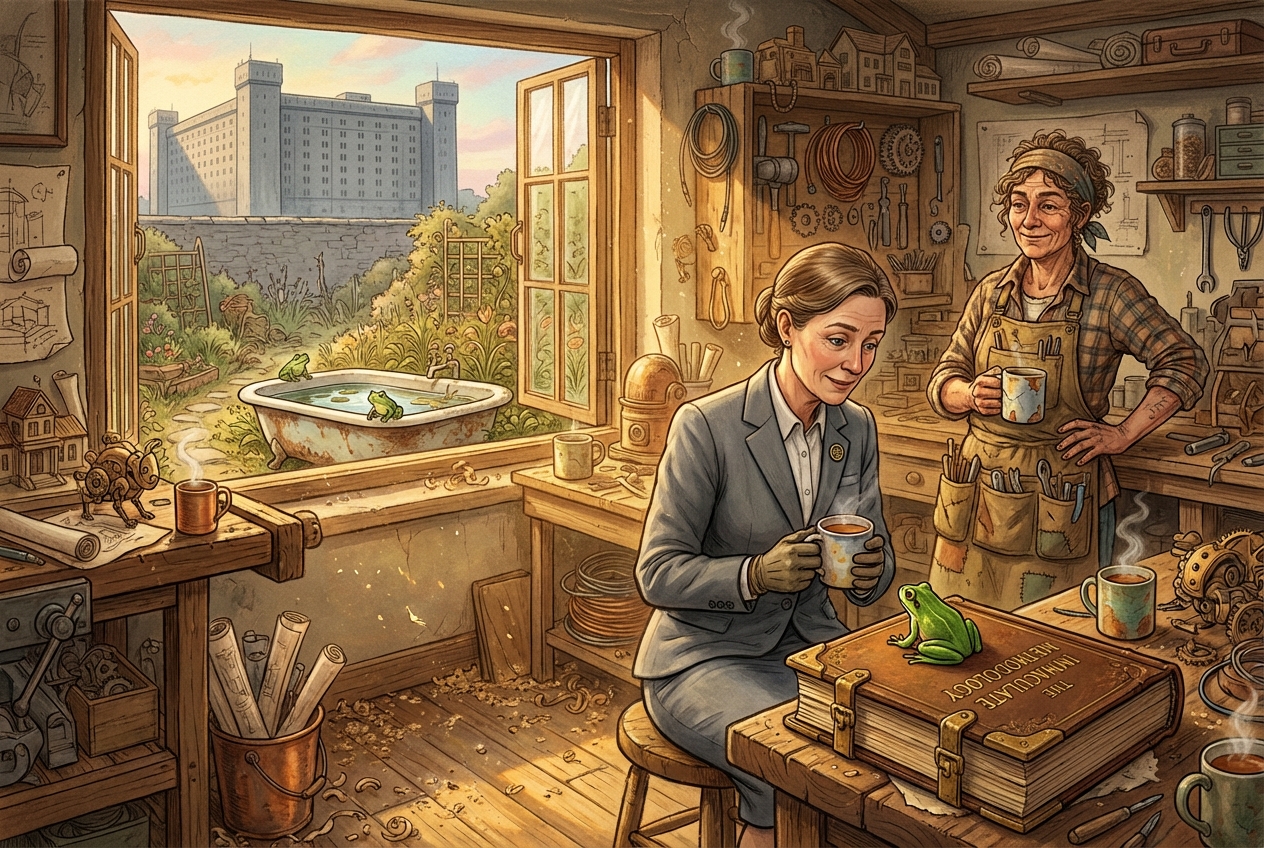
In the city of Processa, which stood on the banks of the River Metric, there lived an Auditor named Mildred Grout.
Mildred was not an Auditor of accounts or buildings or food safety. She was an Auditor of Ways of Working. Her job — and she was very, very good at it — was to visit organizations and measure whether they were Working in the Correct Way.
She carried with her a book. The book was called The Immaculate Methodology, and it was nine hundred pages long, and it described, in exquisite detail, the Correct Way to do everything. The Correct Way to plan. The Correct Way to execute. The Correct Way to reflect on planning and executing. The Correct Way to hold a meeting about the reflection on the planning and the executing.
The book had been written by the Great Founder, who had died long ago, and who — it should be noted — had never actually used the Methodology himself. He had simply observed people working well together and written down what he thought they were doing. This is a bit like watching birds fly and writing a nine-hundred-page manual on Flight, including a certification program, but Mildred did not think about this because it was not in the book.
One morning, Mildred was sent to audit a small workshop on the edge of the city. The workshop made things — what things, exactly, is not important. Useful things. Things people wanted. The workshop had been reported as non-compliant.
(Adams continues:)
The workshop was run by a woman named Pondsmith, which was not her real name but was the name she preferred, because her real name was Darleen, and she felt that “Darleen” did not adequately convey the gravitas of a person who had once built a fully functional interdimensional postbox out of a broken dishwasher and sheer irritation.
Pondsmith’s workshop was, by any objective measure, extraordinarily successful. Things were built. Customers were happy. Workers were — and this was the truly suspicious part — not miserable. They appeared to be having something dangerously close to a good time.
“Where,” said Mildred, opening her book to page 347 (Chapter 12: The Correct Way to Organize Work Into Time-Bounded Increments), “are your sprints?”
“My what?” said Pondsmith.
“Your sprints. Your time-bounded increments of work, preceded by planning, followed by review, culminating in retrospective. Page 347. There’s a diagram.”
Pondsmith looked at the diagram. It was very detailed. It had arrows. The arrows pointed in several directions simultaneously, which is a neat trick for arrows and an impossible trick for work.
“We don’t do that,” said Pondsmith.
Mildred wrote in her audit book: NON-COMPLIANT. No sprints. No visible methodology. Workers appear to be making decisions without a framework. Possible rogue operation. Recommend intervention.
“What do you do?” Mildred asked, with the careful tone of someone documenting a crime scene.
“We look at the thing that needs making,” said Pondsmith. “We talk about it. We argue about it, sometimes. Then someone starts making it. If it’s going wrong, we talk about that too. Then we finish it or we stop.”
“But how do you know it’s going wrong?”
“We look at it,” said Pondsmith.
(Lem continues:)
It was at this point that something unusual happened, which is to say, something happened that was not in the book.
A frog jumped through the open window of the workshop and landed on page 347.
This was, in the grand scheme of things, an insignificant event. Frogs jump. Windows are open. Pages exist. The intersection of these three facts requires no framework to explain. And yet, Mildred found herself staring at the frog with an intensity that surprised her.
The frog was small, green, and appeared entirely unconcerned with the question of whether the workshop was compliant. It sat on the diagram of the Sprint Cycle — directly on the arrow labeled “RETROSPECTIVE” — and it breathed.
“There’s a frog on your methodology,” said Pondsmith, who had the gift of stating the obvious in a way that made the obvious suddenly very interesting.
“I can see that,” said Mildred.
“What are you going to do about it?”
Mildred considered her options. The book did not have a chapter on frogs. This was, she realized, the first situation in her professional career for which the book had no guidance.
She could remove the frog and continue the audit. This was the obvious course of action. The compliant course of action.
But the frog was looking at her with the particular calm of a creature that has never once, in its entire evolutionary history, needed a methodology. Frogs eat when they are hungry. They jump when they are startled. They sit on warm things when they are cold. They have been doing this successfully for three hundred and seventy million years.
The Immaculate Methodology was fourteen years old.
(Vonnegut continues:)
Mildred Grout did something she had never done before. She closed the book.
Not dramatically. Not with a grand revelation. She just closed it because the frog was sitting on it and it seemed rude to disturb the frog. This is how most real changes happen. Not because someone has a breakthrough, but because something small and green is sitting on the thing that was preventing the breakthrough, and it seems easier to let it be.
“Would you like some tea?” said Pondsmith.
“I’m auditing you,” said Mildred.
“You can audit and drink tea simultaneously. It’s not in the book, but it works.”
So Mildred had tea. It was good tea. This is worth mentioning because bad tea has never led to an insight and good tea has led to most of them. This is not in any management book, but it is true.
While drinking tea, Mildred looked around the workshop. She noticed things. She noticed that the workbenches were arranged so that people could see each other’s work without standing up. She noticed that there was a wall where people had pinned sketches — rough, unfinished, some crossed out, some built upon. She noticed that one worker was humming. She noticed that nobody looked afraid.
“How long have you been doing this?” Mildred asked.
“Doing what?”
“Working like this. Without the Methodology.”
“We’ve never worked with the Methodology,” said Pondsmith. “We just work. Sometimes well. Sometimes badly. When it’s bad, we talk about it. When it’s good, we also talk about it, but with more tea and less frowning.”
Mildred wrote in her audit book. She wrote for a long time. The frog watched.
(Pratchett continues:)
When Mildred was finished writing, she tore the page out of her audit book. Then she tore out the next page. And the next. She tore out every page she had ever written about every audit she had ever done, and she stacked them neatly on the table, because she was not the sort of person who littered, even during an existential crisis.
“What will you write in your report?” asked Pondsmith.
“I don’t know yet,” said Mildred. And she smiled, because she realized it was the first time in her professional life she had said “I don’t know” and felt lighter rather than afraid.
The frog jumped off the book, through the window, and into a small pond that existed in the garden behind the workshop. Pondsmith had built the pond herself, out of an old bathtub. It was not an efficient use of an old bathtub. It was not in any way optimized. It simply had water in it, and frogs seemed to like it.
Mildred walked to the window and looked at the pond.
“What do you see?” asked Pondsmith.
“A pond,” said Mildred. “A frog. Some water.”
“Good.”
“That’s it? Just ‘good’?”
“What else would I say? You looked at a thing and saw the thing. Most auditors look at a thing and see the gap between the thing and the book. You just saw the thing. That’s rare. That’s all that matters.”
(Adams continues:)
Mildred Grout walked back to the city of Processa that evening. She walked slowly, which was unusual for her, because the Methodology had a chapter on Optimal Walking Pace (page 203, between “The Correct Way to Prioritize Corridor Conversations” and “Approved Elevator Small Talk Topics”).
She passed the Grand Hall of Methodologies, where twelve hundred certified auditors worked in an open-plan office designed according to the Correct Principles of Workspace Flow. The office was beautiful. The sight lines were perfect. The acoustics were scientifically calibrated. And every single person in it was wearing headphones to block out the noise, which rather defeated the purpose but was not, technically, non-compliant.
She passed the Academy of the Immaculate Methodology, where new auditors were trained. Through the window she could see a class in session. The instructor was drawing a diagram. The diagram had arrows. The students were copying the arrows carefully into their notebooks. None of them were looking at each other.
She passed the Monument to the Great Founder, a bronze statue of a man holding an open book. The statue had been commissioned by the Certification Board. The Great Founder, in life, had been a quiet person who preferred gardens to conferences. He would have hated the statue. But he was dead, and dead people’s preferences are rarely consulted in matters of institutional branding.
Mildred stopped in front of the statue. She looked at it for a long time.
Then she said, quietly, to nobody in particular:
“He was just watching people work. That’s all he was doing. He was watching people work and he saw something beautiful, and he wrote it down, and the writing killed it.”
A pigeon landed on the statue’s head, which was disrespectful and accurate and wonderful.
(Lem writes:)
The next morning, Mildred submitted her audit report. It was the shortest report in the history of the Bureau of Methodological Compliance. It read:
    ┌────────────────────────────────────────────┐
    │                                            │
    │  AUDIT REPORT: PONDSMITH WORKSHOP          │
    │  AUDITOR: M. GROUT                         │
    │  DATE: Tuesday                              │
    │                                            │
    │  FINDINGS:                                  │
    │                                            │
    │  The workshop is non-compliant.            │
    │  The workers are effective.                │
    │  These two facts are related.              │
    │                                            │
    │  RECOMMENDATION:                            │
    │                                            │
    │  Build a pond.                              │
    │                                            │
    └────────────────────────────────────────────┘
The Bureau did not know what to do with this report. It did not fit any existing category. It could not be filed under “Compliant” or “Non-Compliant” or “Pending Remediation.” The Bureau created a new category — “Anomalous” — and filed it there, and then created a committee to study the implications of the new category, and then created a sub-committee to audit the committee, and then life went on exactly as before.
Except for Mildred.
Mildred went home, made a cup of tea, sat by her window, and — for the first time in many years — simply watched. She watched the street. She watched the people. She watched the pigeons, which were disrespectful to all statues equally and therefore the most egalitarian creatures in the city.
She did not try to optimize what she saw. She did not look for process improvements. She did not assess compliance.
She simply watched.
And because this is a story and stories are allowed to do things that methodologies cannot, the watching changed something. Not the city. Not the Bureau. Not the nine-hundred-page book. Those things are very large and very old and very resistant to change, and they will continue being what they are for a long time.
What changed was Mildred.
(Vonnegut finishes:)
On Wednesday, Mildred went back to the workshop. She did not bring her book. She brought a small plant, because she had read somewhere — not in the Methodology, but in a novel she had found at a secondhand shop — that when you visit someone’s workplace, you should bring something alive.
“I’m not here to audit,” she said.
“I know,” said Pondsmith. “You’re here because of the frog.”
“I’m here because of the frog.”
“Good. Would you like to help us make something today? We’re behind on an order and we could use an extra pair of hands.”
“I don’t know how to make things,” said Mildred. “I only know how to measure whether things are made correctly.”
“That’s all right,” said Pondsmith. “Nobody knows how to make things until they make things. The knowing comes from the making, not the other way around.”
So Mildred Grout, Senior Auditor of the Bureau of Methodological Compliance, rolled up her sleeves and made something. It was not good. It was, by any objective measure, the worst version of the thing that the workshop had ever produced.
But she made it with her own hands. And when it was finished — lumpy, imperfect, entirely non-compliant — she held it up and looked at it, and the other workers looked at it, and nobody said anything for a moment.
Then somebody laughed. Not cruelly. Warmly. The way you laugh when someone you like does something clumsy and real. And Mildred laughed too.
Outside, in the pond made from an old bathtub, a frog jumped in.
Nobody heard it.
But it happened anyway.
                    *


          It happened anyway.


    That is the only management advice
    I have ever believed.


    Do the thing. Imperfectly.
    With other people. For no
    guaranteed outcome.


    It will happen anyway.


    The frog does not need you
    to hear it.

    But you might want to listen
    just the same.


                    *
THE END
The four authors sat in silence for a moment after they finished. It was the kind of silence that falls when something has been made that is slightly better than the people who made it, which is the only kind of making worth doing.
“It’s not bad,” said Pratchett.
“It’s not a methodology,” said Adams.
“The frog is perhaps too symbolic,” said Lem. “In The Cyberiad, I would have made it a cybernetic frog with fourteen sub-routines for pond-selection optimization, and the joke would have been better.”
“The joke is fine, Stanisław,” said Pratchett.
“So it goes,” said Vonnegut.
And somewhere, in an office that could be any office, a person closed a book, opened a window, and — for reasons they couldn’t quite articulate — went to find someone to have tea with.
Not to discuss the methodology.
Not to plan the transformation.
Just to sit together, and look at the work, and see what they could see.
The frog was optional.
The pond was already there.
Postscript from the Authors:
Pratchett: “Real stupidity beats artificial intelligence every time.” — Hogfather. But real tea beats both.
Adams: If you’ve read this far and you’re wondering what to do on Monday, here’s my advice: DON’T PANIC. Also, know where your towel is. The towel is a metaphor. The towel is also a towel. Bring a towel.
Lem: I must protest that my contribution was edited for brevity. In the original, the frog had a twelve-page monologue on the epistemological limitations of amphibian consciousness. It was cut. I am told this is “better.” I disagree but I am dead and therefore my disagreement is, as they say, non-blocking.
Vonnegut: Everything was beautiful and nothing hurt. This is a lie, but it’s the right lie to end on. Goodnight.