Written by Piotr Kuczyński with Claude (Anthropic) as writing tool.
The Question
Something happened to Agile.
I’ve watched it deploy, industrialize, and hollow out across a dozen enterprises. The language remains — sprints, standups, retrospectives — but the thing the language once pointed to has disappeared. What started as a radical act of trust in small teams became a compliance framework. What began as a rejection of command-and-control became a new instrument of it.
Everyone senses this. Few say it plainly.
So I wanted to understand: What actually died? And what, if anything, is growing in the cracks?
The Method
This is an AI-staged investigation. I’ve convened perspectives that don’t normally meet — practitioners, theorists, literary minds — and orchestrated structured debates between them using AI as thinking partner.
The voices you’ll encounter are not transcripts of real conversations. They are AI-generated perspectives, each informed by specific thinkers’ published work. Living practitioners appear through descriptive personas (The Complexity Scientist, The Product Strategist). Literary figures whose imaginative universes are the point — Lem, Adams, Pratchett — keep their names.
No one participated in or endorsed these discussions. The perspectives are interpretive, not authoritative. Where they spark your curiosity, follow them to the source. The real thinkers’ work will always be richer than any AI interpretation.
For the full methodology behind all Laboratory experiments, read Why I Make AI Systems Argue Before I Advise. For the ethical framework — the two-layer system, why some names stay and others become personas, what I owe the thinkers I invoke — read The Voices in the Room.
What You’re About to Encounter
The investigation unfolds in four parts:
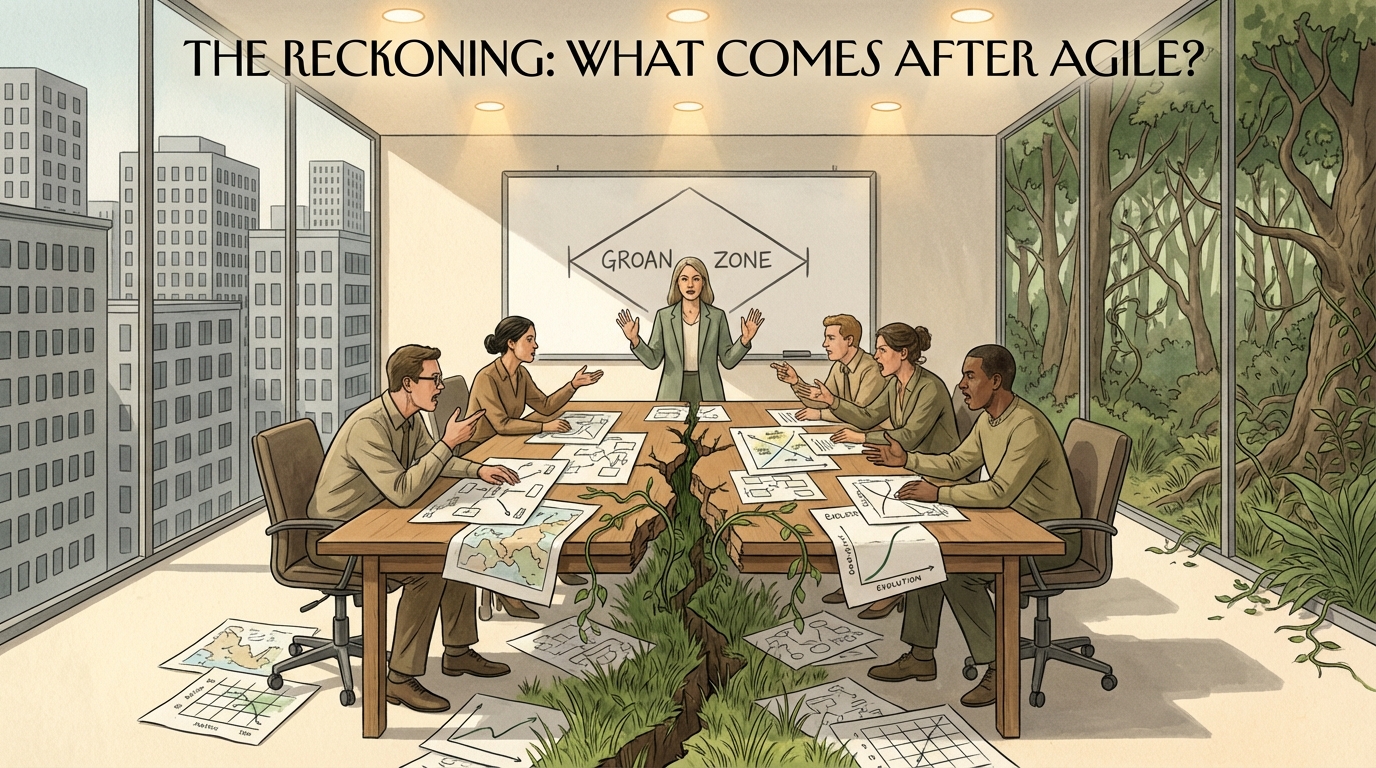
Part I: The Reckoning — Six practitioners autopsy Agile honestly. A complexity scientist, a product strategist, a leadership philosopher, a strategic mapper, a relational dynamics expert — facilitated by someone who knows how to hold difficult conversations. They find what’s already growing in the cracks.
Part II: The Parable of the Framework — The practitioners’ conclusions go to Stanisław Lem, Frank Herbert, Isaac Asimov, and Octavia Butler. They see the civilizational pattern underneath: entropy, power, cycles, and the stubborn act of trying to do meaningful work inside systems that resist it.
Part III: The Map That Ate the Territory — Italo Calvino convenes Borges, Le Guin, a philosopher of exhaustion, and Bashō to examine the strange loop of analyzing analysis. They find what’s missing from all the frameworks: lightness, contemplation, and the frog that jumped into the pond.
Part IV: The Consultation of the Constructors — Lem (as Trurl), Douglas Adams, Terry Pratchett, and Kurt Vonnegut write the comedic finale. No facilitator. Just four dead geniuses, a frog, and something you’ll want to remember.
How to Read This
You can enter at any part. Each stands alone. But there’s a deliberate arc — from practitioner diagnosis, to civilizational pattern, to philosophical reflection, to comedic synthesis. The strangeness is intentional. The collision of frameworks is the point.
The method is the same one I use in executive workshops: orchestrate competing perspectives until something emerges that no single viewpoint could produce alone. The medium is different. The principle is the same.
Begin with Part I: The Reckoning →