February 6, 2026
The Reckoning: What Comes After Agile?
A Facilitated Dialogue
A Writing Lab discussion directed by Piotr Kuczyński. Written with Claude (Anthropic). Participants are fictional personas inspired by named thinkers — full attribution below.
About this discussion: This is an AI-staged conversation produced as part of Innomada’s Writing Lab. The personas represent perspectives informed by named thinkers’ published work — no real person participated in or endorsed this dialogue. Full attribution below.
This is Part I of “What Comes After Agile?” — an AI-staged dialogue exploring what died when Agile was industrialized. About this experiment →
A Facilitated Dialogue
Facilitator: The Facilitation Architect — specialist in designing purposeful conversations that move past polite surface into the territory where real change begins.
Participants:
- The Leadership Philosopher — thinker on purpose-driven organizations and the infinite game mindset
- The Product Strategist — practitioner focused on shaping work before it reaches teams, critic of backlog-driven development
- The Complexity Scientist — researcher on organizational sensemaking, contextual decision-making, and the limits of best practice
- The Strategic Mapper — analyst of value chains, competitive evolution, and situational awareness in strategy
- The Relational Dynamics Expert — practitioner of organizational relationship dynamics, trust, and the emotional underpinnings of change
Format: The Diamond of Participation (Sam Kaner)
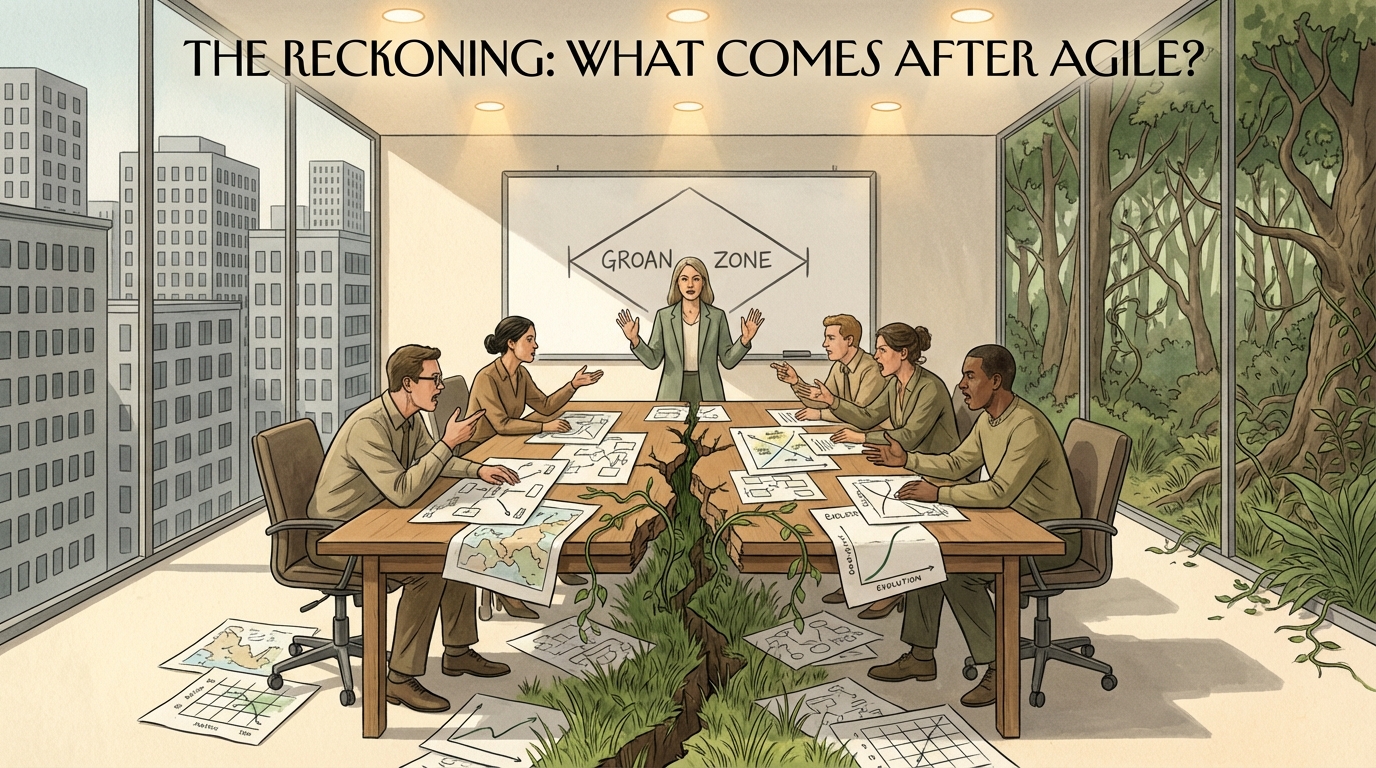
    DIVERGE          GROAN ZONE           CONVERGE

  *  *  *  *       * * * * * * *         *  *  *  *
 *    *    *      *   *   *   *  *        *  *  *
*  *    *   *    *  * COLLISION *  *        * * *
 *   *   *  *     *  *  *  *  *  *          * *
  *    *   *       * * * * * * *              *
                                             ▼
  Opening up       Struggle &            Alignment &
  perspectives     confrontation         commitments
Purpose: Not to mourn Agile, but to autopsy it honestly — and to find what’s already growing in the cracks.
PART I — DIVERGE: “What Happened?”
The Facilitation Architect: Welcome, all of you. I want to set one rule before we begin. This is not a panel. Nobody gets to hide behind their framework. I’ve asked each of you here because you’ve all, in different ways, been saying something is deeply wrong with how organizations try to change. We’re here to figure out what that is — and what comes next.
I’m going to start with a provocation. Agile won. It’s everywhere. Every job posting mentions it. Every consultancy sells it. And yet the people in this room seem to agree that something essential has been lost. So my opening question is simple: What exactly died?
The Complexity Scientist: I’ll go first, because I’ve been saying this the longest and I’m tired of being proven right slowly.
What died is something that was never fully alive. The Agile Manifesto was a reasonable set of heuristics created by people who understood software. Then it was industrialized. The moment you turned a set of contextual practices into a certification pipeline, you killed the epistemic humility that made it work. You replaced sensemaking with sensegiving — here’s the framework, now comply.
What died is not Agile. What died is the possibility of Agile, because the space for it was colonized by a consulting-industrial complex that needed repeatable, scalable products. You can’t scale emergence. But you can sell the illusion that you have.
The Leadership Philosopher: I want to push back on the cynicism there, but I also want to agree with the core of it. What I see is simpler: organizations adopted the practices of Agile without adopting the beliefs of Agile. They wanted the speed and the flexibility, but they didn’t want to give up command and control.
You can’t do standups and sprint reviews and call yourself Agile while your C-suite still operates on annual budgets, cascaded KPIs, and fear-based accountability. Agile died because leaders wanted a tool, not a transformation. They wanted the fruit without changing the soil.
The Product Strategist: I think you’re both being too generous to Agile itself. Let me be blunt: a lot of what was packaged as Agile was always bad practice with good marketing.
Take Scrum. You have a team doing two-week sprints. A Product Owner writes stories. A Scrum Master facilitates. And somehow, nobody in this system is asking the fundamental question: “Is this the right thing to build?”
┌─────────────────────────────────────────────────────┐
│              THE SCRUM BLIND SPOT                    │
│                                                     │
│   Strategy  ──???──▶  Backlog  ──sprint──▶  Output  │
│                        │                            │
│                   Who shaped this?                   │
│                   Who decided scope?                 │
│                   Where is the appetite?             │
│                                                     │
│   Scrum optimizes the RIGHT side.                   │
│   The LEFT side is where value lives or dies.        │
└─────────────────────────────────────────────────────┘
Scrum became a delivery machine disconnected from strategy. That’s not a corruption of Scrum — that’s what Scrum is. It was always a process for the production line, not for the messy, uncertain work of figuring out what to build and why.
The Strategic Mapper: Can I map this? I always want to map things.
The issue is evolution. Every practice goes through stages: Genesis → Custom-Built → Product → Commodity. Agile practices have become commoditized. And when something becomes a commodity, it becomes invisible infrastructure — necessary, but not a source of competitive advantage.
                    Evolution ──────────────────────────▶

  Genesis          Custom           Product          Commodity
  (novel)          (emerging)       (good practice)  (utility)
     │                │                 │                │
     │                │                 │                │
     │                │            ┌────┴────┐     ┌────┴────┐
     │                │            │ "Agile" │     │ CI/CD   │
     │           ┌────┴────┐      │ methods  │     │ Standups│
     │           │ Cynefin │      │ Coaching │     │ Sprints │
     │           │ Mapping │      └─────────-┘     │ Retros  │
     │           │ ShapeUp │                       └─────────┘
  ┌──┴───┐      └─────────┘
  │ ???  │         ▲
  │ Next │         │
  │ thing│    WE ARE SOMEWHERE
  └──────┘    IN HERE
The problem is that the Agile industry is trying to sell a commodity as if it were still novel. That’s like selling electricity as a breakthrough innovation. Meanwhile, the actual novel practices — the ones that deal with genuine uncertainty, strategy, and organizational design — are still in the genesis and custom stages. The Agile label is actively preventing organizations from finding them.
The Relational Dynamics Expert: May I offer a completely different lens?
I listen to all of you and I hear systems, frameworks, maps. But I work with the relational fabric of organizations, and what I see is this: Agile asked organizations to be vulnerable, and organizations don’t know how to be vulnerable.
Agile, at its best, asked people to say “I don’t know.” It asked leaders to trust teams. It asked for transparency, for admitting mistakes in retrospectives, for showing unfinished work. These are all acts of relational risk.
And most organizations are built on the exact opposite — on the performance of certainty, on the appearance of control, on hierarchy as emotional armor. You cannot retrofit trust into a system designed to eliminate the need for it.
What died wasn’t Agile. What died was the illusion that you could have the benefits of vulnerability — innovation, speed, engagement — without actually being vulnerable. And that illusion was very profitable for a lot of consultants.
The Facilitation Architect: I want to sit with what was just said about relational dynamics. Because I think something was named that the rest of you are circling around from different angles. One voice is talking about epistemic humility. Another about beliefs. Another about the courage to engage with uncertainty about what to build. Another about honestly seeing where things are on the evolution curve.
All of these require a kind of organizational honesty that most companies are structurally incapable of.
Let me push us forward. We know what happened. What is actually emerging right now that’s different?
PART II — THE GROAN ZONE: Collision of Ideas
The Product Strategist: I’ll say what I think is next, and it’s going to be unpopular in this room. What’s next is less process, more shaping. The biggest leverage point in any product organization is the moment before work begins — when someone decides “this is the problem, this is roughly the appetite, and this is the boundaries of the solution.”
Shape Up exists because I watched teams drown in backlogs. A backlog is organizational debt disguised as planning. What you need instead is:
┌──────────────────────────────────────────────────┐
│                  SHAPING                          │
│                                                   │
│  1. RAW IDEA        "Users can't find settings"   │
│        │                                          │
│        ▼                                          │
│  2. APPETITE         "We'll spend 2 weeks on it"  │
│        │              (not: estimate how long)     │
│        ▼                                          │
│  3. BOUNDARIES       Fat-marker sketch:           │
│        │                                          │
│        │             ┌───────────────┐            │
│        │             │ ┌──┐  search  │            │
│        │             │ └──┘  ~~~~~~  │            │
│        │             │  ○ setting A  │            │
│        │             │  ○ setting B  │            │
│        │             │  ○ setting C  │            │
│        │             └───────────────┘            │
│        │                                          │
│        │              Shaped, not specified.       │
│        ▼                                          │
│  4. PITCH & BET      Senior people decide:        │
│                       "Yes, we bet on this."       │
│                       (or: "Not now.")             │
└──────────────────────────────────────────────────┘
The team gets a shaped problem with clear boundaries and real authority to solve it within the appetite. No backlog. No sprint planning theater. No estimation poker.
The Complexity Scientist: I appreciate the practicality, but what was just described is a solution for complicated problems — problems where the relationship between cause and effect is knowable in advance. You can shape a UI redesign. You cannot shape a market disruption or a cultural transformation.
The issue is that organizations face all types of problems simultaneously, and they need different approaches for each:
┌────────────────────────┬────────────────────────┐
│       COMPLEX          │      COMPLICATED       │
│                        │                        │
│  Probe → Sense →       │  Sense → Analyze →     │
│  Respond               │  Respond               │
│                        │                        │
│  Safe-to-fail exps.    │  Expert analysis       │
│  Parallel coherent     │  Shape Up works here   │
│  experiments           │  Good practice         │
│  Sensemaking           │                        │
│                        │                        │
│  "What's emerging?"    │  "What's the answer?"  │
├────────────────────────┼────────────────────────┤
│       CHAOTIC          │       CLEAR            │
│                        │                        │
│  Act → Sense →         │  Sense → Categorize →  │
│  Respond               │  Respond               │
│                        │                        │
│  Novel practice        │  Standard process      │
│  Crisis management     │  Automation            │
│                        │  Checklists            │
│  "Just do something"   │                        │
│                        │  "Follow the rules"    │
│                        │                        │
└────────────────────────┴────────────────────────┘
         (Cynefin Framework — simplified)
Agile’s failure was treating everything as if it were in the complicated domain. “Follow the Scrum process and you’ll get good outcomes.” That’s a complicated-domain move. But the real challenges — the ones Piotr’s user is asking about — live in the complex domain. And in complex systems, you don’t plan and execute. You create conditions for emergence and you pay attention to what happens.
The Leadership Philosopher: I hear the point on the framework, but I want to challenge something. The last few contributions are all describing better methods. And I think the fundamental problem is upstream of methods entirely.
The question is not “what methodology should we use.” The question is “what game are we playing?”
┌─────────────────────────────────────────────────┐
│                                                 │
│  FINITE GAME              INFINITE GAME         │
│  ─────────                ─────────────         │
│  Known players            Known & unknown        │
│  Fixed rules              Changeable rules       │
│  Agreed objective         Perpetuate the game    │
│                                                 │
│  Quarterly targets ◄──── Most orgs play ────►   │
│  Ship the feature         here, even when the   │
│  Hit the velocity         actual game is here    │
│  Pass the audit                                 │
│                           Build capability       │
│                           Sustain trust          │
│                           Stay relevant          │
│                                                 │
└─────────────────────────────────────────────────┘
When organizations adopted Agile, they made it a finite game move: “We’ll do Agile to deliver faster.” But the Manifesto was an infinite game document. It was about building the kind of organization that could continuously adapt. The moment you measure Agile by velocity, you’ve already lost.
The Relational Dynamics Expert: Simon, I want to build on what you’re saying about the game, because there’s a relational dimension here everyone is dancing around.
Why do organizations default to the finite game? It’s not stupidity. It’s anxiety management. Certainty is a defense mechanism. When I work with couples, I see the same pattern: the relationship is dying, and both partners respond by increasing control. More rules, more check-ins, more surveillance. The relationship needed more space, more risk, more aliveness — and instead it got more structure.
This is exactly what happened to Agile. Organizations were anxious about uncertainty, so they hired Scrum Masters to create the illusion of control through ritual. The daily standup became surveillance. The retrospective became performance. The sprint review became a demo to impress stakeholders, not a genuine moment of learning.
The Scrum Master became the couple’s therapist who was hired by one partner to fix the other one.
The Strategic Mapper: [leaning forward] That metaphor is disturbingly accurate.
Let me add the strategic dimension. The reason organizations resist real transformation is that they confuse their map of the world with the actual territory. They have a strategy based on assumptions about what creates value. When reality shifts, instead of updating the map, they double down on it.
WHAT LEADERS THINK THEY'RE DOING:

   "We know"  ────────────────────▶  "We execute"
   (Strategy)                        (Delivery)
       │                                 │
       │          "Agile helps            │
       │           us here"              │
       ▼                                 ▼
   Board sets    ═══════════════▶   Teams sprint
   direction                        on backlog


WHAT'S ACTUALLY HAPPENING:

   "We guess"  ───── ??? ────▶  "We discover"
   (Assumption)     Gap!         (Learning)
       │           ▲   ▲            │
       │           │   │            │
       │       Nobody             │
       │       owns this          │
       │       space              │
       ▼                            ▼
   HiPPO decides               Teams build
   what to build                the wrong thing
                                efficiently
That gap in the middle — between assumption and learning — is where all the value is. And it’s the one place that no current methodology adequately addresses. Shape Up gets close for product work. Cynefin gets close for organizational work. But neither has cracked the problem of making leaders themselves into learners rather than deciders.
The Facilitation Architect: We’re in the groan zone now. I can feel it. One of you is saying the solution is better upstream design. Another that it’s understanding the nature of the problem first. Another that it’s a mindset shift about what game you’re playing. Another that it’s strategic awareness. And another that none of it works without relational safety.
Let me make this uncomfortable: Are any of you actually disagreeing, or are you all describing different parts of the same elephant?
The Complexity Scientist: [with an edge] We’re partially describing the same elephant, but the prescriptions are radically different. The leadership perspective wants to inspire leaders to think differently. I want to constrain the system so that different behavior emerges regardless of what leaders believe. That’s not a superficial difference — that’s a fundamental epistemological divide.
I don’t believe in transformation through inspiration. I believe in transformation through altered constraints. You change the information flows, the decision rights, the feedback loops — and new behavior emerges. You don’t need the CEO to have a revelation. You need the system to make the old behavior harder and the new behavior easier.
The Leadership Philosopher: And I’d argue that without a reason — without a “why” — people will resist those constraint changes. You can redesign the system all you want, but if people don’t understand why they’re being asked to work differently, they’ll find ways to game any system you create.
The Product Strategist: Can I be the pragmatist here? Both of you are right and both of you are irrelevant to the person sitting in a Monday morning planning meeting wondering what to do differently this week.
The problem with the Agile coaching world is that it operates at the altitude of complexity thinking and purpose philosophy — big ideas about systems and meaning — and then lands at the altitude of ceremonies and roles. There’s no middle layer. There’s no practical “here’s how you actually decide what to work on, scope it, and build it” that isn’t either too abstract or too ritualistic.
┌─────────────────────────────────────────────────┐
│          THE MISSING MIDDLE                      │
│                                                  │
│  ALTITUDE 1: Philosophy / Purpose                │
│  "Play the infinite game" "Embrace complexity"   │
│  ═══════════════════════════════════════════     │
│                     ▲                            │
│                     │  GAP                       │
│                     │  (Where coaches live       │
│                     │   but have no tools)       │
│                     ▼                            │
│  ALTITUDE 2: Strategy / Shaping                  │
│  "What to build" "How much appetite"             │
│  "What are the boundaries"                       │
│  ═══════════════════════════════════════════     │
│                     ▲                            │
│                     │  GAP                       │
│                     ▼                            │
│  ALTITUDE 3: Execution / Ceremonies              │
│  "Daily standup" "Sprint review" "Retro"         │
│                                                  │
│  Most "Agile" operates ONLY at Altitude 3.       │
│  The best minds argue about Altitude 1.          │
│  Almost nobody works at Altitude 2.              │
└─────────────────────────────────────────────────┘
The Relational Dynamics Expert: I want to challenge that gently. You say the missing middle is about what to build and how to scope it. But I think the missing middle is also about how people relate to each other while they do the work.
When a senior leader shapes a problem and bets on it — to use your language — that requires trust. The leader trusts the team to solve it. The team trusts the leader that the appetite is real and won’t change mid-cycle. Both sides trust that failure in a bet is acceptable.
That trust doesn’t come from a methodology. It comes from accumulated experiences of psychological safety that is tested and survived. Not the kind where everyone is polite in retrospectives, but the kind where someone says “this bet was wrong and here’s what I learned” and their career doesn’t end.
The Strategic Mapper: And I’d add: that trust requires situational awareness. You can’t trust leadership if leadership is visibly operating from a wrong map. I’ve seen teams that had psychological safety and great methodologies and still failed because they were building in the wrong part of the value chain.
The thing that frustrates me about the Agile conversation is that it’s entirely inward-facing. How do we work? How do we collaborate? How do we deliver? Nobody is asking: Where are we in the competitive landscape, and is this work even relevant?
The Facilitation Architect: I want to capture what just happened, because I think we found it. The collision point. Let me play it back:
The Product Strategist says: The gap is in shaping — deciding what to build and with what appetite. The Complexity Scientist says: The gap is in understanding problem complexity — using the right approach for the right situation. The Leadership Philosopher says: The gap is in purpose — playing the right game. The Strategic Mapper says: The gap is in strategic awareness — knowing where you are. The Relational Dynamics Expert says: The gap is in relational capacity — the ability to trust and be trusted.
And Piotr’s original provocation sits underneath all of this: the people who were supposed to help organizations close these gaps — the Agile coaches, the Scrum Masters — have been boxed into ceremony facilitators at the team level.
So let me ask the convergence question: What would it look like if we actually addressed all of these simultaneously? And who does that work?
PART III — CONVERGE: What Emerges
The Complexity Scientist: I’ll start with what I think the actual role should be. Not an “Agile Coach.” Not a “Scrum Master.” What organizations need is what I’d call an organizational sensemaker — someone who can help leaders and teams see what kind of problem they’re facing and choose appropriate responses.
This person’s toolkit is not Scrum or SAFe. It’s:
- Contextual assessment (what domain are we in?)
- Constraint management (what small changes shift the system?)
- Narrative and sensemaking (what are people actually experiencing?)
- Safe-to-fail experimental design
And critically — this person must have executive access. Not to coach the CEO on their leadership style, but to help the organization see its own patterns. The biggest failure of Agile coaching is that it was positioned as a team-level intervention for what is fundamentally an organizational-level problem.
The Strategic Mapper: I agree on the altitude, but I’d add that this person needs to be strategically literate. They need to understand value chains, evolution, and competitive dynamics. Otherwise, they’re helping the organization be better at things that don’t matter.
Here’s what I think the “next thing” looks like:
┌───────────────────────────────────────────────────────┐
│         THE NEXT PRACTICE (not framework)              │
│                                                        │
│  1. SEE THE LANDSCAPE                                  │
│     Wardley Maps, value chain analysis                 │
│     "Where are we? Where is the market moving?"        │
│                                                        │
│  2. UNDERSTAND THE PROBLEM TYPE                        │
│     Cynefin assessment                                 │
│     "Is this complex, complicated, or clear?"          │
│                                                        │
│  3. SHAPE THE WORK (for complicated/clear)             │
│     Appetite, boundaries, fat-marker sketches          │
│     "What are we willing to spend on this?"            │
│                                                        │
│  4. PROBE THE SPACE (for complex)                      │
│     Safe-to-fail experiments, parallel probes          │
│     "What can we learn cheaply?"                       │
│                                                        │
│  5. BUILD RELATIONAL CAPACITY (continuous)             │
│     Trust, candor, vulnerability practices             │
│     "Can we be honest about what we're seeing?"        │
│                                                        │
│  6. REFLECT ON PURPOSE (continuous)                    │
│     Infinite game check, "why" alignment               │
│     "Is this still the game we want to play?"          │
│                                                        │
│  ┌─────────────────────────────────────────────┐       │
│  │  NOT a sequential process.                  │       │
│  │  A set of CAPABILITIES the organization     │       │
│  │  needs to exercise situationally.           │       │
│  └─────────────────────────────────────────────┘       │
└───────────────────────────────────────────────────────┘
The Product Strategist: I like this, but I want to ground it. Because if I’m a practitioner hearing this, I’m thinking “great, another meta-framework.” Let me say what I think should happen on Monday morning:
-
Kill the backlog. Seriously. It’s a graveyard of half-considered ideas creating the illusion of a plan. Replace it with a betting table — a regular, time-boxed decision point where senior people look at shaped pitches and say yes or no.
-
Give teams shaped problems, not task lists. The pitch should describe the problem, the appetite (how much time), and the boundaries — not the solution.
-
Protect the build cycle. Once a team has a bet, nobody interrupts. No new tickets. No “quick asks.” Six weeks of focused, uninterrupted work.
-
Accept that some bets will fail. If every bet succeeds, your bets aren’t ambitious enough.
This is not a revolution. It’s a set of concrete decisions that change the power dynamics in the organization. The team gains real autonomy. Leadership gains real strategic decision-making. And the middle layer of process bureaucracy evaporates.
The Leadership Philosopher: I want to bring this back to the human layer, because the practical advice just offered is good but insufficient on its own. You can implement Shape Up perfectly and still have a toxic organization.
What I believe comes next is not a methodology at all. It’s a leadership practice. The finite game of “deliver features” needs to be embedded in the infinite game of “build an organization where great people want to do great work.”
That means:
- Leaders who measure themselves by the growth of their people, not just the output of their teams.
- Organizations that treat trust as infrastructure, not a nice-to-have.
- A willingness to sacrifice short-term efficiency for long-term adaptability.
If I were advising Agile coaches, I’d say: Stop coaching processes. Start coaching purpose. Help leaders articulate why their organization exists beyond making money. Then help them see every decision — including methodology choices — through that lens.
The Relational Dynamics Expert: And I would add something that none of you have said, because it’s uncomfortable for a room full of thinkers and builders.
The “next thing after Agile” requires grief.
Organizations that went through Agile transformations made promises. “You’ll have autonomy. You’ll be empowered. Your voice matters.” Many of those promises were broken. People are cynical now not because they’re resistant to change, but because they’ve been burned by change. They did the vulnerable thing — they trusted — and the organization let them down.
Before you can introduce the next approach, you have to acknowledge what happened. Not a retrospective. Not a lessons-learned. An honest reckoning. “We said Agile would change things. In some ways it did. In many ways we failed you. Here’s what we’re going to do differently and here’s why you should consider trusting this.”
Without that, every new initiative — no matter how brilliant — will be received as “management’s next fad.”
┌───────────────────────────────────────────────┐
│          THE TRUST RECOVERY CYCLE              │
│                                                │
│   ┌──────────┐                                 │
│   │  1. Name │  "We promised autonomy and      │
│   │  what    │   delivered micromanagement      │
│   │  broke   │   with new vocabulary."          │
│   └────┬─────┘                                  │
│        ▼                                        │
│   ┌──────────┐                                  │
│   │  2. Own  │  "That's on leadership,          │
│   │  it      │   not on the teams."             │
│   └────┬─────┘                                  │
│        ▼                                        │
│   ┌──────────┐                                  │
│   │  3. Small│  "Here's one concrete thing      │
│   │  credible│   that changes THIS WEEK."       │
│   │  action  │                                  │
│   └────┬─────┘                                  │
│        ▼                                        │
│   ┌──────────┐                                  │
│   │  4. Let  │  "We'll check in. You tell       │
│   │  them    │   us if it's real."              │
│   │  verify  │                                  │
│   └──────────┘                                  │
│                                                 │
│   Repeat. Slowly. For months. Not days.         │
└─────────────────────────────────────────────────┘
The Facilitation Architect: I want to honor what was just brought in about grief and trust. Because it changes the nature of the advice we’re giving.
We’re not just asking “what’s the next framework?” We’re asking: “How do you begin again when trust has been damaged?”
Let me try to synthesize what I’ve heard. And I want each of you to tell me if I’m getting it wrong.
SYNTHESIS: Three Outcomes
Outcome 1: What About Agile?
The Facilitation Architect: Here’s what I heard about Agile:
Agile as a set of values — collaboration, responsiveness, learning, human agency — remains as relevant as ever. Perhaps more so. These are not trend-dependent principles.
Agile as an industry — certifications, frameworks, roles, ceremonies — has entered commodity phase and has been captured by a consulting-industrial complex that optimizes for its own survival rather than client outcomes. The practices themselves are not wrong, but they’ve been applied universally rather than contextually, and at the wrong organizational altitude.
The core failure: Agile was positioned as a team-level delivery methodology when the problems it was trying to solve — adaptability, innovation, engagement — are organizational and relational challenges that require executive engagement, strategic awareness, and genuine vulnerability.
Agile isn’t dead. It was misdiagnosed — prescribed as a team-level treatment for an organizational-level condition.
  WHAT AGILE PROMISED         WHAT AGILE DELIVERED
  ───────────────────         ────────────────────
  Adaptive organizations  →   Adaptive teams trapped in
                               rigid organizations

  Customer collaboration  →   Sprint reviews where
                               stakeholders watch demos

  Responding to change    →   Changing sprint content
                               while strategy stays fixed

  Individuals &           →   "Resources" renamed to
  interactions                 "team members" but
                               managed the same way
Outcome 2: What’s Next After Agile?
The Facilitation Architect: What emerged from the collision of your perspectives is not a single framework. It’s a constellation of capabilities that organizations need to develop:
┌─────────────────────────────────────────────────────────────┐
│                                                             │
│              THE POST-AGILE CAPABILITY MAP                  │
│                                                             │
│    ┌──────────────┐    ┌──────────────┐                     │
│    │  STRATEGIC    │    │  CONTEXTUAL  │                     │
│    │  AWARENESS    │    │  FLUENCY     │                     │
│    │              │    │              │                     │
│    │              │    │              │                     │
│    │  Know where   │    │  Match the   │                     │
│    │  you are and  │    │  approach to │                     │
│    │  where the    │    │  the problem │                     │
│    │  landscape is │    │  type        │                     │
│    │  moving       │    │              │                     │
│    └──────┬───────┘    └──────┬───────┘                     │
│           │                   │                              │
│           ▼                   ▼                              │
│    ┌────────────────────────────────────┐                    │
│    │       SHAPING & BETTING            │                    │
│    │                                    │                    │
│    │                                    │                    │
│    │  Decide what to work on, with what │                    │
│    │  appetite, and give teams real     │                    │
│    │  autonomy within boundaries        │                    │
│    └──────────────┬─────────────────────┘                    │
│                   │                                          │
│           ┌───────┴────────┐                                 │
│           ▼                ▼                                  │
│    ┌──────────────┐ ┌──────────────┐                         │
│    │  RELATIONAL  │ │  PURPOSE     │                         │
│    │  CAPACITY    │ │  ALIGNMENT   │                         │
│    │              │ │              │                         │
│    │              │ │              │                         │
│    │  Trust as    │ │  Infinite    │                         │
│    │  practice,   │ │  game check: │                         │
│    │  not outcome.│ │  why are we  │                         │
│    │  Candor.     │ │  doing this? │                         │
│    │  Grief work. │ │              │                         │
│    └──────────────┘ └──────────────┘                         │
│                                                              │
│    BINDING PRINCIPLE:                                        │
│    These are not sequential. They are not a framework.       │
│    They are capabilities exercised SITUATIONALLY based       │
│    on what the moment demands. The skill is knowing          │
│    WHICH capability to reach for WHEN.                       │
│                                                              │
└──────────────────────────────────────────────────────────────┘
What’s next is not a successor framework. It’s the end of framework-thinking itself. What replaces it is contextual fluency — the ability to read situations and respond with the right approach, drawn from a rich repertoire, rather than applying the same method everywhere.
This is harder to sell. Harder to certify. Harder to scale. And that’s exactly why it might work — because the things that can be easily sold, certified, and scaled are the things that get commoditized and hollowed out.
Outcome 3: What Agile Coaches Can Do
The Facilitation Architect: This is the question closest to Piotr’s heart. What do people who’ve invested their careers in Agile transformation actually do now?
Let me channel what each of you would say, and then land on a synthesis.
The Complexity Scientist would say: Stop being a process coach. Become a sensemaker. Learn to read complexity. Help organizations see what kind of problem they’re actually facing before they reach for a solution. Your value is not in knowing Scrum — it’s in knowing when Scrum is the wrong answer.
The Strategic Mapper would say: Become strategically literate. Learn to map. If you can’t help leadership see the competitive landscape, you’ll never get a seat at the table. Your current lack of C-suite access is because you’re offering tactical help for what leaders see as strategic challenges.
The Product Strategist would say: Learn product thinking. Learn to shape work. The biggest gap in most organizations isn’t how teams work — it’s how work gets to teams. If you can help organizations make better bets about what to build, you become indispensable.
The Leadership Philosopher would say: Shift from coaching process to coaching leadership. Help leaders understand the infinite game. Help them see that their people’s engagement, trust, and growth are not soft metrics — they are the only metrics that matter in the long run.
The Relational Dynamics Expert would say: Become skilled in the relational dimension of organizational life. Learn to facilitate real conversations — not retrospectives, but the kind where people say what’s actually happening. Help organizations grieve failed transformations before launching new ones. The human capacity for trust is your real domain.
The synthesis:
┌───────────────────────────────────────────────────────────────┐
│                                                               │
│  THE AGILE COACH'S EVOLUTION PATH                             │
│                                                               │
│                                                               │
│  FROM                          TO                             │
│  ────                          ──                             │
│                                                               │
│  Process facilitator      →    Organizational sensemaker      │
│  Team-level scope         →    Executive + team scope         │
│  Framework expert         →    Context-fluent practitioner    │
│  "How we work"            →    "What to work on & why"        │
│  Ceremony guardian        →    Strategic conversation          │
│                                enabler                        │
│  Retrospective            →    Honest reckoning               │
│  facilitator                   facilitator                    │
│  Change agent             →    Trust rebuilder                │
│                                                               │
│                                                               │
│  CONCRETE INVESTMENTS:                                        │
│                                                               │
│  ┌─────────────────────────────────────────────────────────┐  │
│  │                                                         │  │
│  │  1. LEARN TO MAP (Wardley Mapping)                      │  │
│  │     → Gives you strategic vocabulary that earns         │  │
│  │       executive respect                                 │  │
│  │                                                         │  │
│  │  2. LEARN COMPLEXITY (Cynefin, SenseMaker)              │  │
│  │     → Gives you the ability to say "this approach       │  │
│  │       is wrong for this problem" with authority         │  │
│  │                                                         │  │
│  │  3. LEARN PRODUCT SHAPING (Shape Up, JTBD)              │  │
│  │     → Gives you practical tools for the "missing        │  │
│  │       middle" between strategy and execution            │  │
│  │                                                         │  │
│  │  4. LEARN RELATIONAL FACILITATION                       │  │
│  │     → Not Scrum ceremonies. Real dialogue.              │  │
│  │       Fierce Conversations. Immunity to Change.         │  │
│  │       The Art of Gathering.                             │  │
│  │                                                         │  │
│  │  5. DEVELOP A "WHY" PRACTICE                            │  │
│  │     → Help leaders articulate purpose beyond            │  │
│  │       profit. Connect daily work to meaning.            │  │
│  │                                                         │  │
│  └─────────────────────────────────────────────────────────┘  │
│                                                               │
│  THE MOST IMPORTANT SHIFT:                                    │
│  Stop introducing yourself as an "Agile Coach."               │
│  You are someone who helps organizations                      │
│  navigate complexity, make better strategic decisions,         │
│  and build the relational trust required to act on them.      │
│                                                               │
│  The label limits you before you open your mouth.             │
│                                                               │
└───────────────────────────────────────────────────────────────┘
CLOSING
The Facilitation Architect: Before we close, I want to go around the room one more time. One sentence each. What do you want the person reading this to actually do differently tomorrow?
The Complexity Scientist: Run one safe-to-fail experiment this week instead of planning a transformation program.
The Strategic Mapper: Draw a map of your organization’s value chain before your next strategy meeting. You’ll be shocked at what you see.
The Product Strategist: Pick the one thing your team is most confused about and shape it — define the problem, set an appetite, draw the boundaries. Then hand it to the team and get out of the way.
The Leadership Philosopher: Ask your team one question tomorrow: “What would you do differently if you weren’t afraid?” Then listen. That’s where the real work begins.
The Relational Dynamics Expert: Before you launch the next change initiative, ask the people who lived through the last one: “What do we owe you?” You might not like the answer, but you need to hear it.
The Facilitation Architect: And from me: the next time you’re about to facilitate a meeting, ask yourself — what is this gathering for? Not the agenda. The purpose. If you can’t name it in one sentence, cancel the meeting.
The conversation doesn’t end here. It continues in every standup where someone dares to say “I don’t think this sprint makes sense.” In every executive meeting where someone pulls out a map instead of a roadmap. In every organization brave enough to say “we got it wrong, and here’s what we’re going to try next.”
Agile isn’t dead. The industrial version of Agile is dying. What comes next has no name yet — and maybe that’s exactly the point.
Intellectual Sources
The perspectives in this discussion draw on the following thinkers and works:
The Facilitation Architect — informed by the work of Priya Parker, particularly The Art of Gathering: How We Meet and Why It Matters (2018). Parker’s approach to purposeful gathering shapes the facilitation methodology used here.
The Complexity Scientist — informed by the work of Dave Snowden, particularly the Cynefin framework and Cynefin: Weaving Sense-Making Into the Fabric of Our World (2020). Snowden’s research on complexity, sensemaking, and the limits of best practice provides the foundation for contextual decision-making.
The Strategic Mapper — informed by the work of Simon Wardley, particularly Wardley Mapping and his research on strategic evolution. Free resources at learnwardleymapping.com.
The Product Strategist — informed by the work of Ryan Singer, particularly Shape Up: Stop Running in Circles and Ship Work that Matters (2019, free at basecamp.com/shapeup). Singer’s critique of backlog-driven development and his shaping methodology address the “missing middle” between strategy and execution.
The Leadership Philosopher — informed by the work of Simon Sinek, particularly Start With Why (2009) and The Infinite Game (2019). Sinek’s framework on purpose-driven leadership and finite vs. infinite game thinking shapes the discussion of organizational meaning.
The Relational Dynamics Expert — informed by the work of Esther Perel, particularly How’s Work? podcast and her research on relational dynamics in organizational settings. Perel’s lens on trust, vulnerability, and the emotional dimension of work provides the relational foundation.
Additional framework: The Diamond of Participation model comes from Sam Kaner’s Facilitator’s Guide to Participatory Decision-Making (2014).
Perspectives were generated using AI prompted with specific thinkers’ bodies of work. Published personas protect individual identity while preserving intellectual attribution. If you are a thinker whose work informed this discussion and you have concerns, please contact Piotr directly.