February 6, 2026
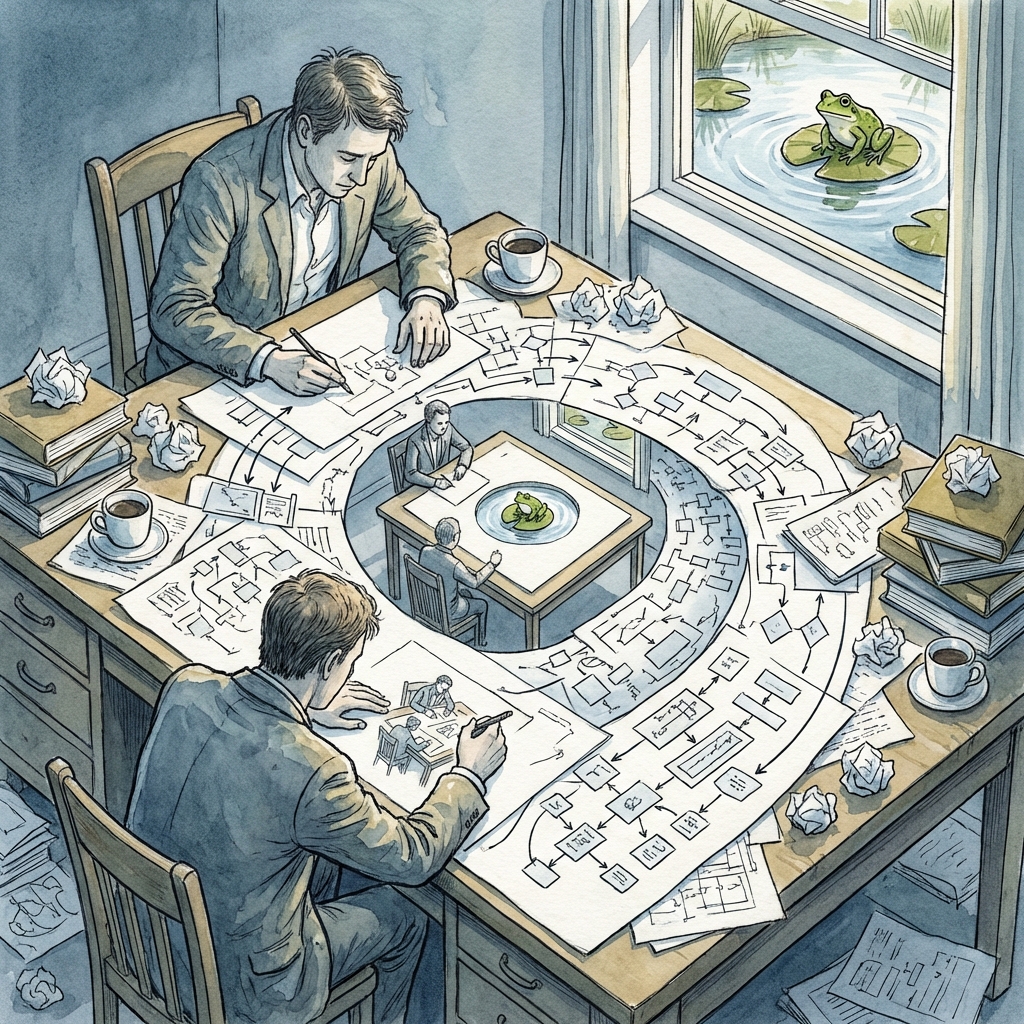
The Map That Ate the Territory
A Discussion About the Two Discussions, and the Silence Beneath Them
A Writing Lab discussion directed by Piotr Kuczyński. Written with Claude (Anthropic). Participants are fictional personas inspired by named thinkers — full attribution below.
About this discussion: This is an AI-staged conversation produced as part of Innomada’s Writing Lab.
The literary voices — Calvino, Borges, Le Guin, Bashō — retain their names because their imaginative universes are inseparable from the insights they offer. One participant uses a descriptive persona informed by a living philosopher’s work. We have edited direct claims of authorship while preserving analytical perspectives.
No one — living or deceased — participated in or endorsed this conversation. Full attribution below.
This is Part III of “What Comes After Agile?” — continuing the civilizational reflection from Parts I and II. About this experiment →
A Discussion About the Two Discussions, and the Silence Beneath Them
Facilitator: Italo Calvino — the writer who understood that every attempt to describe the world creates a new world that must then be described. His Six Memos for the Next Millennium proposed that literature needs Lightness, Quickness, Exactitude, Visibility, Multiplicity — and a sixth quality he never finished.
Participants:
- Jorge Luis Borges — the blind librarian who saw everything, cartographer of infinities
- Ursula K. Le Guin — the Taoist anarchist who carried stories in a bag, not a sword
- The Philosopher of Exhaustion — thinker on the burnout society, the disappearance of contemplation, and the violence of positivity
- Matsuo Bashō — haiku master, walker, the one who arrived at simplicity after a lifetime of complexity
Calvino: I have asked four people into a room that does not exist, to discuss two discussions that never happened, about a problem that may not be a problem.
I should explain why I am the one holding this.
Six Memos for the Next Millennium proposed that the qualities literature needs for the future are: Lightness, Quickness, Exactitude, Visibility, Multiplicity, and a sixth that was never finished — Consistency.
I mention this because it is relevant. The two discussions we have read — one among practitioners, one among visionaries — are both attempts at exactitude and multiplicity. They map the problem beautifully. But they are heavy. They accumulate layer upon layer of analysis, and each layer, while brilliant, adds weight.
I want to ask whether the thing that is missing from both discussions is lightness. Not frivolity — lightness. The ability to be precise about serious things without being crushed by them.
But I will let my guests speak. Borges, you have read both discussions. What did you see?
I. THE LIBRARY
Borges: I saw a library.
Let me explain. In both discussions, intelligent people built systems of ideas. The first group — the practitioners — constructed a map. The Cynefin domains, the Wardley evolution curve, the shaping methodology, the infinite game, the trust recovery cycle. A map of maps. A framework for choosing frameworks.
The second group — Lem, Herbert, Asimov, Butler — looked at this map and said: “But this map will also be metabolized. This map will also decay. The cycle is the cycle.” And then they built a meta-map: the four layers, the three paths, the phase transition diagram.
Now you have invited a third group to look at both maps and say… what?
I will tell you what I see. I see the Library of Babel.
    THE LIBRARY OF BABEL — ORGANIZATIONAL EDITION
    ══════════════════════════════════════════════

    Imagine a library containing every possible
    book about how to organize human work.

    ┌─────────────────────────────────────────────┐
    │ ┌─────┐ ┌─────┐ ┌─────┐ ┌─────┐ ┌─────┐  │
    │ │SCRUM│ │LEAN │ │SAFe │ │SHAPE│ │?????│  │
    │ │     │ │     │ │     │ │ UP  │ │     │  │
    │ └─────┘ └─────┘ └─────┘ └─────┘ └─────┘  │
    │ ┌─────┐ ┌─────┐ ┌─────┐ ┌─────┐ ┌─────┐  │
    │ │CYNE-│ │WARD-│ │EARTH│ │TEAL │ │?????│  │
    │ │ FIN │ │ LEY │ │SEED │ │     │ │     │  │
    │ └─────┘ └─────┘ └─────┘ └─────┘ └─────┘  │
    │ ┌─────┐ ┌─────┐ ┌─────┐ ┌─────┐ ┌─────┐  │
    │ │META │ │META │ │META │ │META │ │?????│  │
    │ │MAP 1│ │MAP 2│ │MAP 3│ │MAP 4│ │     │  │
    │ └─────┘ └─────┘ └─────┘ └─────┘ └─────┘  │
    │                                            │
    │ ┌─────┐ ┌─────┐ ┌─────┐ ┌─────┐ ┌─────┐  │
    │ │META │ │META │ │META │ │META │ │?????│  │
    │ │META │ │META │ │META │ │META │ │     │  │
    │ │MAP 1│ │MAP 2│ │MAP 3│ │MAP 4│ │     │  │
    │ └─────┘ └─────┘ └─────┘ └─────┘ └─────┘  │
    │                                            │
    │              · · · · · ·                   │
    │               (infinite)                   │
    │                                            │
    │  The library contains:                     │
    │                                            │
    │  - Every methodology that has existed       │
    │  - Every methodology that could exist       │
    │  - Every critique of every methodology      │
    │  - Every critique of every critique          │
    │  - THIS DISCUSSION                          │
    │  - Every possible response to it            │
    │                                            │
    │  Somewhere on a shelf is the PERFECT book   │
    │  — the one that solves the problem forever. │
    │                                            │
    │  It is indistinguishable from the           │
    │  millions of books that are nonsense.       │
    │                                            │
    └─────────────────────────────────────────────┘
The librarians of Babel went mad. Not because the library lacked the truth, but because it contained the truth — along with every possible corruption of it, and no way to distinguish one from the other.
This is the condition of the person reading these discussions. They are standing in the Library. Every shelf offers a framework, a meta-framework, a critique of meta-frameworks. The more they read, the more they know, and the less capable they become of acting.
The first discussion said: “Here are better maps.” The second said: “All maps decay.” I am saying: the accumulation of maps is itself the disease.
Le Guin: Jorge, you’ve described the trap perfectly. But you’ve done it in a way that is itself the trap. You’ve built a beautiful, recursive metaphor — the Library that contains all libraries — and it’s so elegant that people will admire it and feel paralyzed.
There is a different kind of story to find. Not the hero’s quest. Not the Library. Not the map. It’s called the Carrier Bag Theory of Fiction.
The oldest human tool is not the weapon. It is the bag. The sling. The container. The thing that lets you carry seeds home. Human civilization began not with the dramatic kill but with the patient gathering. And the stories we need are not about heroes solving problems — they are about people carrying things together over distance.
    TWO KINDS OF STORY ABOUT WORK
    ═════════════════════════════

    THE HERO STORY                THE CARRIER BAG STORY
    (arrow, spear, framework)     (basket, net, practice)

         │                              .  · .
         │                           .    ·    .
         │                          ·  seeds    ·
         │                          ·  tools    ·
         │     ◁────── versus ──▶   ·  stories  ·
         │                          ·  scraps   ·
         │                           ·  doubts  ·
         ▼                            ·   ·   ·
       TARGET                          · · ·


    Linear                        Non-linear
    A solves B                    Things are carried together
    Climax and resolution         Ongoing, seasonal, cyclical
    The hero transforms           The community sustains

    "We'll implement Shape Up     "We'll keep gathering what
     and fix the organization"     works, discarding what
                                   doesn't, and walking
                                   together"
Both discussions we read are hero stories. In the first, the heroes are the practitioners who will replace Agile with something better. In the second, the heroes are the visionaries who see the civilizational pattern that the practitioners can’t.
But what if the answer is not a hero? What if it’s a bag?
What if the person reading this doesn’t need a quest — doesn’t need to “transform” or “evolve” or “transcend” — but simply needs a better bag? A way of carrying the contradictions of their work without dropping them or being crushed by them?
The Philosopher of Exhaustion: I want to interrupt, because I believe Ursula is closer to the truth than anyone in either discussion, but I want to name why the hero story persists despite its failure.
We live in what I call the achievement society. It has replaced the disciplinary society of the twentieth century. The disciplinary society said “you must” and “you must not.” The achievement society says “you can.” It sounds like liberation. It is a more sophisticated form of domination.
    THE SHIFT NO ONE IN THE AGILE DISCUSSION NAMED
    ═══════════════════════════════════════════════

    DISCIPLINARY SOCIETY              ACHIEVEMENT SOCIETY
    (20th century)                    (21st century)

    ┌──────────────────┐              ┌──────────────────┐
    │                  │              │                  │
    │   YOU MUST       │              │   YOU CAN        │
    │   comply         │              │   optimize       │
    │   obey           │              │   grow           │
    │   conform        │              │   transform      │
    │                  │              │   disrupt        │
    │   Power comes    │              │   innovate       │
    │   FROM OUTSIDE   │              │                  │
    │                  │              │   Power comes    │
    │   The boss       │              │   FROM INSIDE    │
    │   tells you      │              │                  │
    │   what to do     │              │   YOU tell you   │
    │                  │              │   what to do     │
    │                  │              │                  │
    │   Produces:      │              │   Produces:      │
    │   obedience      │              │   burnout        │
    │   resentment     │              │   depression     │
    │   rebellion      │              │   self-blame     │
    │                  │              │                  │
    └──────────────────┘              └──────────────────┘

    THE CRITICAL INSIGHT:

    Agile was born as a REBELLION against
    the disciplinary society.

    "Individuals over processes!"
    "Self-organizing teams!"
    "Autonomy!"

    But it was immediately absorbed into
    the achievement society:

    "You are EMPOWERED to deliver more."
    "You are AUTONOMOUS — and accountable
     for your velocity."
    "You are SELF-ORGANIZING — and here is
     the SAFe framework to self-organize within."

    ┌─────────────────────────────────────────┐
    │                                         │
    │  The achievement society does not need   │
    │  to OPPRESS you.                        │
    │                                         │
    │  It just needs to make you              │
    │  OPPRESS YOURSELF                       │
    │  and call it empowerment.               │
    │                                         │
    └─────────────────────────────────────────┘
This is what I find absent from both discussions. The first discussion asks: “How do we fix the methodology?” The second asks: “Can the cycle be broken?” Neither asks: “What is this relentless drive to optimize doing to the human beings inside it?”
Octavia Butler came closest when she spoke of daily practice. But even her Earthseed discipline — morning questions, midday noticing, evening connection — risks becoming another self-optimization routine. Another item on the checklist of the exhausted achiever.
The thing that is truly missing — from Agile, from post-Agile, from both discussions — is contemplation. The capacity to do nothing. To not optimize. To sit with a problem without reaching for a solution. To let a silence be silent.
Calvino: Byung-Chul, I want to hold that word — contemplation — because I think it connects to what Bashō has been doing this entire time, which is sitting quietly while the rest of us talk.
Bashō, you have been silent. I suspect deliberately. Will you speak?
Bashō:
The others build. I have been listening to the rain.
Calvino: [smiling] Perhaps you could say a little more?
Bashō: I walked the narrow road to the deep north for five months. I did not walk to arrive. I walked to walk. What I found — what I always found — was that the insight came not from thinking but from attending. From being present to the thing in front of me until it revealed itself.
You have all been very intelligent about a simple problem. Let me state the simple problem:
People want their work to matter. Their organizations make it not matter. They suffer.
This is not new. The haiku tradition understood it three hundred years ago. The samurai poets knew it. The monks knew it. The farmers knew it.
    ┌──────────────────────────────────┐
    │                                  │
    │       The old pond.              │
    │                                  │
    │       A frog jumps in.           │
    │                                  │
    │       Sound of water.            │
    │                                  │
    └──────────────────────────────────┘

    This is everything the two discussions
    are trying to say.

    There is a reality       (the pond).
    Something happens        (the frog).
    You attend to it         (the sound).

    You do not need a Cynefin diagram
    to know which domain the frog is in.

    You do not need a Wardley Map to know
    where the pond sits in the value chain.

    You need to be PRESENT.
    Present to the pond.
    Present to the frog.
    Present to the sound.

    The rest is commentary.
Le Guin: [laughing quietly]
He’s right, and it’s infuriating, and he’s right.
Borges: He is right in the way that only a poet can be right — which is to say, he has said the thing that cannot be argued with because it operates beneath argument.
But I want to resist, Bashō, because the people reading this cannot sit by a pond. They are in an office. They have a quarterly review. They have a Jira board. The pond is a metaphor, and metaphors do not attend Monday standups.
Bashō: You are wrong. The pond is not a metaphor. The Monday standup is the pond. The Jira board is the pond. The quarterly review is the pond.
The frog jumps in every meeting. Someone says something true. Someone’s face changes. A silence falls that nobody fills. Something real happens. But nobody hears the sound of water because they are too busy referring to the map of the pond that they made in the last meeting.
II. THE STRANGE LOOP
Calvino: Something is happening in this conversation that I want to name, because I think it is the answer, and we will miss it if I don’t.
We have now had three nested discussions:
    THE STRANGE LOOP
    ════════════════

    DISCUSSION 1 (Practitioners):
    "How do we fix the way organizations work?"
    ┌──────────────────────────────────────────┐
    │                                          │
    │  Built: maps, capabilities, tools        │
    │  Missed: the civilizational pattern      │
    │                                          │
    │  DISCUSSION 2 (Visionaries):             │
    │  "What does Discussion 1 reveal          │
    │   about civilization?"                   │
    │  ┌──────────────────────────────────┐    │
    │  │                                  │    │
    │  │  Built: cycles, paths, warnings  │    │
    │  │  Missed: the act of building     │    │
    │  │  itself as the problem           │    │
    │  │                                  │    │
    │  │  DISCUSSION 3 (Us):              │    │
    │  │  "What do both discussions       │    │
    │  │   reveal about the nature of     │    │
    │  │   seeking itself?"               │    │
    │  │  ┌────────────────────────┐      │    │
    │  │  │                        │      │    │
    │  │  │  Building: this.       │      │    │
    │  │  │  Missing: ???          │      │    │
    │  │  │                        │      │    │
    │  │  │  ┌──────────────┐      │      │    │
    │  │  │  │ Discussion 4 │      │      │    │
    │  │  │  │  ┌────────┐  │      │      │    │
    │  │  │  │  │  ...   │  │      │      │    │
    │  │  │  │  └────────┘  │      │      │    │
    │  │  │  └──────────────┘      │      │    │
    │  │  └────────────────────────┘      │    │
    │  └──────────────────────────────────┘    │
    └──────────────────────────────────────────┘

    Each layer CORRECTLY identifies what the
    previous layer missed. And each layer, in
    the act of identifying it, creates a new
    layer that misses something else.

    This is not a flaw. This is the STRUCTURE
    OF CONSCIOUSNESS ITSELF.

    You cannot think your way to the end of
    thinking. You can only — at some point —

                     stop.
This is what Hofstadter called a strange loop — a system that, by moving through its levels, arrives back at itself. The practitioners build tools. The visionaries see the pattern of building. We see the pattern of seeing patterns. A fourth group would see the pattern of seeing patterns of seeing patterns. And so on, forever. The Library of Babel.
The only escape from the loop is the one Bashō demonstrated: step out of the loop entirely. Attend to the thing in front of you.
But even that becomes a method the moment I say it. “Step out of the loop” becomes Step 1 in a new framework. This is the joke that the universe is playing on all of us, and it is very funny if you can bear to laugh.
The Philosopher of Exhaustion: It is not funny. Or rather — it is funny in the way that burnout is funny. The strange loop you describe, Italo, is not merely an intellectual curiosity. It is the engine of exhaustion.
Every new layer of meta-analysis creates a new obligation. The practitioner must learn Scrum. Then they must learn why Scrum is insufficient. Then they must learn Cynefin and Wardley Maps. Then they must understand the civilizational pattern of framework decay. Then they must understand the strange loop. Then they must learn to step out of the strange loop. Then they must learn why “stepping out” is itself a strange loop.
    THE EXHAUSTION SPIRAL
    ═════════════════════

    Layer 1: "Learn the framework"
             │
             ▼  (exhausting)
    Layer 2: "Learn why the framework is wrong"
             │
             ▼  (more exhausting)
    Layer 3: "Learn the meta-pattern"
             │
             ▼  (even more exhausting)
    Layer 4: "Learn to see the strange loop"
             │
             ▼  (breaking point)
    Layer 5: "Learn to step out"
             │
             ▼  (but stepping out is another step)
    Layer 6: ...
             │
             ▼

    ┌──────────────────────────────────────────┐
    │                                          │
    │  At some point the person just           │
    │                                          │
    │            stops.                        │
    │                                          │
    │  Not enlightenment.                      │
    │  Not transcendence.                      │
    │                                          │
    │  Exhaustion.                             │
    │                                          │
    │  And the system calls this               │
    │  "disengagement" and hires               │
    │  a new coach to fix it.                  │
    │                                          │
    └──────────────────────────────────────────┘
This is what I mean when I say contemplation is the missing element. Not contemplation as another practice to add to the list. Contemplation as refusal. The refusal to add another layer. The refusal to optimize. The refusal to seek.
The Agile coach who burns out is not weak. They are sane. They have correctly intuited that the game is rigged — that every solution generates a new problem, that every meta-level generates a new meta-level, and that the system requires their perpetual striving precisely because perpetual striving is what the system feeds on.
Le Guin: Byung-Chul, you have just described the problem so precisely that I want to respond with the most precise thing I know, which is a story.
Not a framework. A story.
In my novel The Dispossessed, there is a physicist named Shevek who lives on an anarchist moon. The moon has no government, no hierarchy, no frameworks. And it is — slowly, invisibly — developing its own orthodoxies. Its own informal hierarchies. Its own ways of controlling people through social pressure instead of formal authority.
Shevek’s revolution is not to fix the system. It is to leave and come back. He goes to the capitalist planet, sees its horrors and its freedoms. He returns to the anarchist moon, sees its freedoms and its horrors. And what he brings back is not a solution. It is a wall that has been broken.
    THE DISPOSSESSED: A MAP FOR THE AGILE COACH
    ════════════════════════════════════════════

    THE WALL
    ────────

    On one side: the world of Frameworks.
    Scrum, SAFe, LeSS, Shape Up, Cynefin.
    Order, certification, process, method.
    Safety through structure.

    On the other side: the world of Freedom.
    No method. Pure responsiveness.
    Chaos, intuition, relationship.
    Aliveness through risk.

    ┌─────────────────╫─────────────────┐
    │                 ║                 │
    │   FRAMEWORKS    ║    FREEDOM      │
    │                 ║                 │
    │   Safe          ║    Alive        │
    │   Repeatable    ║    Unrepeatable │
    │   Teachable     ║    Unteachable  │
    │   Dead          ║    Dangerous    │
    │                 ║                 │
    └─────────────────╫─────────────────┘
                      ║
                      ║
              The wall between them
              is the belief that you
              must choose one side.

              Shevek's gift was not
              a better theory.

              It was a HOLE IN THE WALL.

              ┌──────────┐
              │          │
              │    ──    │
              │   /  \   │
              │  |    |  │
              │   \  /   │
              │    ──    │
              │          │
              └──────────┘

              The ability to pass
              freely between order
              and chaos.

              Not choosing. CARRYING.
              Both. At once. In a bag.
This is what I would say to the Agile coach, the person in the LACE team, the person in the standup who feels the hollowness:
You do not need to choose between the framework and the freedom. You do not need to replace Agile with something better. You need to learn to move through the wall — to use structure when structure serves, to abandon it when it doesn’t, and to carry the knowledge of both sides without collapsing into either.
This is not a framework. It is a capacity. And it is — I think — what Butler meant by “shaping Change.”
Borges: Ursula, you have done something remarkable. You have described the Library of Babel and then — instead of trying to catalog it or escape it — you have proposed walking through its walls.
I want to add one thing. In my story The Garden of Forking Paths, there is a novel that contains all possible plots simultaneously. Every decision branches into every possible outcome. The novel is unintelligible — not because it is nonsensical, but because it contains too much sense. Every path is valid. Every choice leads to a coherent story. The reader is paralyzed not by confusion but by infinite coherence.
This is the condition of the person who has read both our previous discussions. They now see:
    THE GARDEN OF FORKING PRACTICES
    ═══════════════════════════════

    You could:

    ├── Learn Wardley Mapping
    │   ├── and become strategically literate
    │   │   ├── and gain C-suite access
    │   │   │   ├── and change the organization
    │   │   │   └── and be co-opted by the organization
    │   │   └── and realize strategy is also a construct
    │   └── and discover that maps also decay
    │
    ├── Learn Cynefin
    │   ├── and become a sensemaker
    │   │   ├── and help others see complexity
    │   │   │   ├── and be valued
    │   │   │   └── and watch Cynefin get commoditized
    │   │   └── and realize sensemaking is also ideology
    │   └── and discover that complexity theory is also
    │       a simplification
    │
    ├── Adopt Shape Up
    │   ├── and improve product decisions
    │   │   ├── and see real results
    │   │   └── and watch it become the next Scrum
    │   └── and discover it doesn't address power
    │
    ├── Practice Earthseed
    │   ├── and develop inner stability
    │   │   └── and risk turning practice into
    │   │       self-optimization
    │   └── and discover even "shaping Change"
    │       is a form of control
    │
    ├── Sit by the pond with Bashō
    │   ├── and find peace
    │   │   └── and lose your job
    │   └── and realize you can't sit by a pond
    │       when you have children to feed
    │
    └── Read one more discussion about it
        └── (you are here)


    EVERY PATH IS VALID.
    EVERY PATH HAS A COST.
    NO PATH IS FINAL.

    The question is not "which path?"
    The question is "can you walk
    WITHOUT NEEDING to know
    that you've chosen the right one?"
Calvino: We’re arriving somewhere. I can feel it. Let me try to name where.
Borges has shown us: the accumulation of maps is infinite and no map is final. Ursula has shown us: the answer is not to choose a side but to move through the wall. Byung-Chul has shown us: the seeking itself is exhausting, and the exhaustion is structural, not personal. Bashō has shown us: the pond is always there, and always has been.
So what is left?
III. WHAT IS LEFT
Bashō: May I?
Calvino: Please.
Bashō:
I will tell you about my journey to the deep north.
I prepared for months. I studied. I planned. I consulted maps. I packed provisions. I arranged travel companions and correspondence. I left instructions for my students.
Then I left, and none of the preparation mattered. The road taught me the road. The rain taught me the rain. The exhaustion taught me exhaustion. My companion Sora and I walked, and the walking was the teacher, not the preparation for it.
There is a field where Yoshitsune’s warriors died centuries ago. All the glory, all the strategy, all the heroism — reduced to summer grasses. The haiku goes:
    ┌──────────────────────────────────────┐
    │                                      │
    │                                      │
    │       Summer grasses —               │
    │                                      │
    │           all that remains           │
    │                                      │
    │               of warriors' dreams    │
    │                                      │
    │                                      │
    └──────────────────────────────────────┘
Replace “warriors” with “Agile coaches.” Replace “summer grasses” with whatever your organization looks like in twenty years. You will have the same poem.
This is not nihilism. The warriors mattered. Their dreams mattered. And the grass that grew from their dreaming also matters. But the grass does not care about the dream. The grass is simply what grew.
You are asking: “What comes after Agile?” You are asking: “What should a person do in this moment of transition?”
Here is what I know:
    ┌──────────────────────────────────────────────┐
    │                                              │
    │  THE NARROW ROAD                             │
    │  ═══════════════                             │
    │                                              │
    │  Do not seek to follow in the footsteps      │
    │  of the masters.                             │
    │                                              │
    │  Seek what they sought.                      │
    │                                              │
    │  ○                                           │
    │                                              │
    │  Snowden sought: clarity about what          │
    │  kind of situation you're in.                │
    │                                              │
    │  Wardley sought: honest seeing of            │
    │  where things are.                           │
    │                                              │
    │  Singer sought: the courage to decide        │
    │  before you're certain.                      │
    │                                              │
    │  Sinek sought: a reason that survives        │
    │  the method.                                 │
    │                                              │
    │  Perel sought: the quality of attention      │
    │  between people.                             │
    │                                              │
    │  Lem sought: honesty about what cannot       │
    │  be solved.                                  │
    │                                              │
    │  Herbert sought: awareness of power's        │
    │  invisible mechanics.                        │
    │                                              │
    │  Asimov sought: the long pattern that        │
    │  holds across time.                          │
    │                                              │
    │  Butler sought: the daily practice of        │
    │  becoming what you need to become.           │
    │                                              │
    │  ○                                           │
    │                                              │
    │  These are not different things.             │
    │  They are the same thing                    │
    │  seen from different distances.             │
    │                                              │
    │  The thing itself is:                        │
    │                                              │
    │                                              │
    │          ATTENTION.                           │
    │                                              │
    │                                              │
    │  Attention to the situation.                  │
    │  Attention to the landscape.                  │
    │  Attention to the decision.                   │
    │  Attention to the purpose.                    │
    │  Attention to each other.                     │
    │  Attention to what cannot be fixed.           │
    │  Attention to power.                          │
    │  Attention to time.                           │
    │  Attention to change.                         │
    │                                              │
    │  Not a framework for attention.               │
    │  Not a certification in attention.            │
    │                                              │
    │                                              │
    │           Just                                │
    │                                              │
    │           attention.                          │
    │                                              │
    │                                              │
    └──────────────────────────────────────────────┘
Calvino: [very quietly]
I think we have arrived.
Let me say what I believe we’ve found, and then I want to end with something light, because this has been very heavy and the world needs lightness as much as it needs depth.
WHAT THE THREE DISCUSSIONS SAY, TOGETHER
    THE THREE LAYERS, RECONCILED
    ════════════════════════════

    DISCUSSION 1 asked: "What tools do we need?"
    Answer: many. Use them situationally.
    This is USEFUL and INSUFFICIENT.

    DISCUSSION 2 asked: "What pattern are we in?"
    Answer: a civilizational cycle of idea → decay.
    This is TRUE and PARALYZING.

    DISCUSSION 3 asked: "What is beneath the pattern?"
    Answer:


                 ┌─────────────────┐
                 │                 │
                 │    A person     │
                 │    paying       │
                 │    attention    │
                 │                 │
                 └─────────────────┘


    That's it. That's the irreducible element.
    Everything else is infrastructure for that.

    The frameworks are infrastructure for attention.
    The meta-frameworks are infrastructure for attention.
    The strange loops are what happen when
    infrastructure becomes more interesting
    than the thing it was built to support.
Le Guin: I want to name one more thing before we finish. Because I think there’s a danger in what we’ve just said — the danger of making “attention” into another individual practice, another solitary discipline, another achievement for the exhausted self.
Attention is not solitary. Attention is relational. The frog does not jump into the pond for Bashō alone. The sound of water is heard by everyone around the pond. The question is not “are you paying attention?” but “are you paying attention together?”
    THE CARRIER BAG OF ATTENTION
    ════════════════════════════

    You do not need:
    ─────────────────
    ✗ A framework that will not decay
    ✗ A meta-framework that explains the decay
    ✗ A meta-meta-framework that explains the
      explaining
    ✗ Enlightenment
    ✗ The right certification
    ✗ Permission from the C-suite

    You need:
    ─────────
    ✓ Two or three other people
    ✓ A real problem
    ✓ The willingness to attend to it honestly
    ✓ The courage to say "I don't know"
    ✓ The patience to let the answer emerge
      instead of manufacturing it

    This is not a methodology.
    This is MONDAY MORNING.

    The question is not what system to use.
    The question is whether you and the two
    people next to you can look at the same
    pond and hear the same frog.

    If you can, no framework is necessary.
    If you can't, no framework will help.
The Philosopher of Exhaustion: And I would add: allow that gathering to sometimes produce nothing. The most radical act in the achievement society is to come together and not optimize. To meet and not have an action item. To sit with a problem and let it remain a problem.
The burnout epidemic is not a failure of methodology. It is the success of a system that has colonized every moment with purpose. Even rest is now “recovery.” Even play is now “creativity technique.” Even silence is now “mindfulness practice.”
The person reading this has been given, across three discussions, an extraordinary amount of insight. My counsel: do not turn it into a plan. Sit with it. Let it compost. See what grows.
The grass does not hurry.
Borges: I will close my contribution with this. I once wrote about a map so detailed that it was the same size as the territory it described. The cartographers eventually abandoned it, and it decayed in the desert, and in its ruins, animals made their homes.
These three discussions are a map. A very beautiful, very detailed map. And like all maps, their highest purpose is to be set down — so that you can look up and see the territory with your own eyes.
The territory is your work. Your colleagues. Your Monday morning. Your specific, unrepeatable, uncertifiable situation.
No map will walk it for you.
Bashō:
    ┌──────────────────────────────────────┐
    │                                      │
    │                                      │
    │      The map set down —              │
    │                                      │
    │           at last, the road          │
    │                                      │
    │               begins                 │
    │                                      │
    │                                      │
    └──────────────────────────────────────┘
Calvino:
Thank you all. I promised lightness, so let me end with this.
Everything in these three discussions — every framework, every meta-framework, every strange loop, every haiku — can be reduced to one image:
         ○ ○
        (people)
          │
          │ looking at
          │
          ▼
     ┌─────────┐
     │ ~ ~ ~ ~ │
     │  ~ ~ ~  │
     │   ~ ~   │  ← the work, the world,
     │    ~    │     the thing in front of them
     └─────────┘
          │
          │ together
          │
          ▼

         ?

     (whatever emerges)
The frameworks tell you how to look. The meta-frameworks tell you what you’re looking at. The strange loops tell you that looking at looking is also looking.
And the frog — the frog just jumps.
Three discussions. Fifteen voices. Ten thousand words. And what remains is this: the quality of your attention to the person next to you, in the presence of a shared problem, without the need for the answer to arrive on schedule.
This has always been true. It was true before Agile. It will be true after whatever comes next. The frameworks rise and fall like summer grasses over the dreams of warriors, and the pond remains, and the frog remains, and the sound of water is available to anyone who stops, for one moment, and listens.
Post-session reading list:
The participants were asked: “One book, not your own.”
- Borges: The Book of Disquiet — Fernando Pessoa. “Because it is the most honest book about what it is like to think too much.”
- Le Guin: Braiding Sweetgrass — Robin Wall Kimmerer. “Because she carries indigenous and scientific knowledge in the same bag without dropping either.”
- The Philosopher of Exhaustion: The Need for Roots — Simone Weil. “Because attention was her word before the burnout society made it a productivity term. And she meant it more seriously than anyone since.”
- Bashō: The Tao Te Ching — Lao Tzu. “The frog learned it from the water.”
- Calvino: Invisible Cities. “Forgive me. But I genuinely believe it is the right book for this moment. Every city in it is a city you have worked in.”
Intellectual Sources
The perspectives in this discussion draw on the following thinkers and works:
Italo Calvino (facilitator) — literary voice drawing on Invisible Cities (1972), If on a winter’s night a traveler (1979), and Six Memos for the Next Millennium (1988). Calvino’s exploration of lightness as a literary and philosophical virtue — the ability to be precise about serious things without being crushed by them — frames this entire discussion.
Jorge Luis Borges — literary voice drawing on Ficciones (1944), The Library of Babel (1941), and Labyrinths (1962). Borges’s explorations of infinite libraries, infinite regress, and the paradoxes of mapping and categorization provide the recursive structure of the critique.
Ursula K. Le Guin — literary voice drawing on The Carrier Bag Theory of Fiction (1986), the Earthsea cycle, and The Left Hand of Darkness (1969). Le Guin’s feminist critique of the hero narrative and her vision of stories as containers rather than weapons offers an alternative to framework-thinking.
The Philosopher of Exhaustion — informed by the work of Byung-Chul Han, particularly The Burnout Society (2010), The Scent of Time (2009), and The Transparency Society (2012). Han’s analysis of achievement society, the disappearance of contemplation, and the violence of positivity provides the diagnosis of why modern work is exhausting.
Matsuo Bashō — literary voice drawing on The Narrow Road to the Deep North (1702) and his haiku tradition. Bashō’s practice of direct attention, simplicity after complexity, and the spiritual dimension of ordinary moments offers a way out of the Library.
The literary voices in this discussion are AI-generated interpretations of these authors’ creative and intellectual legacies. They are tributes, not reproductions. The real authors’ work will always be richer than any AI interpretation. If you are a rights holder with concerns, please contact Piotr directly.