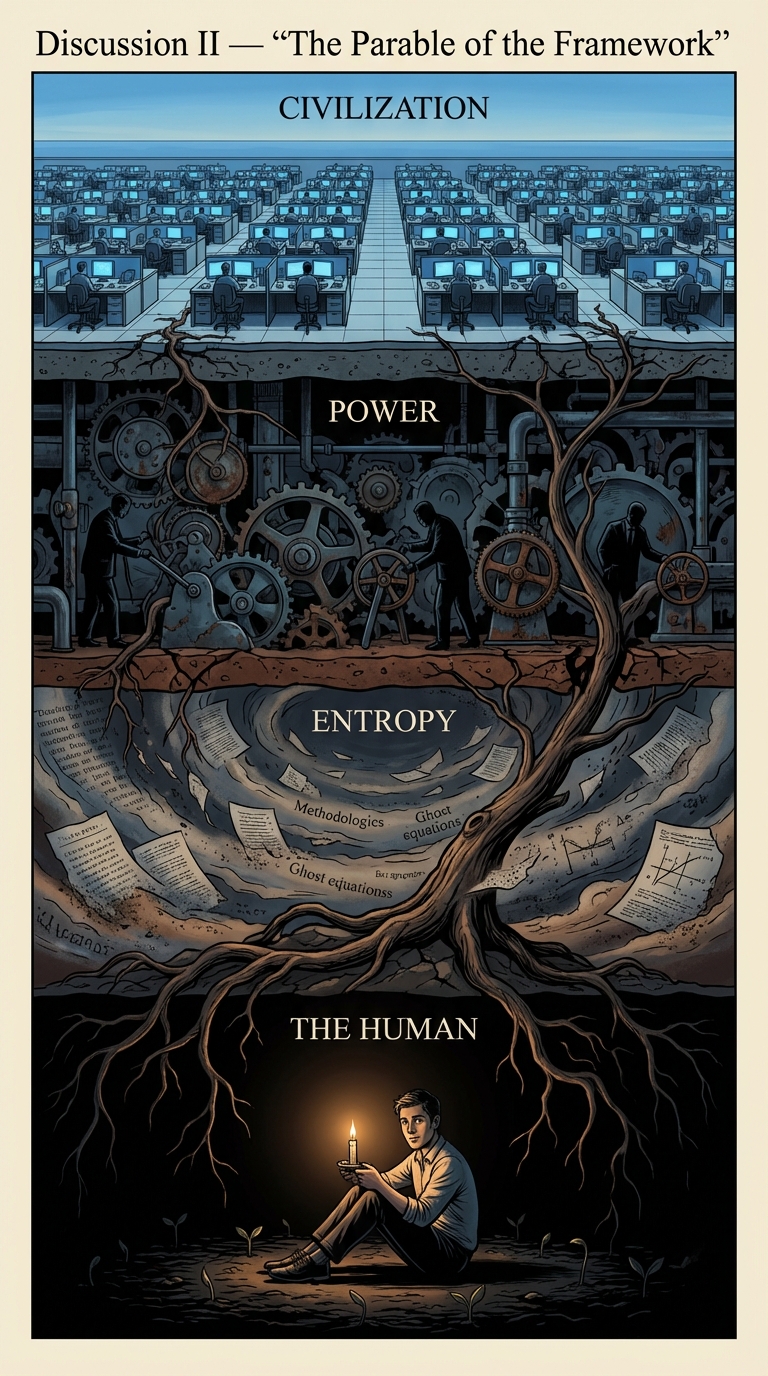
February 6, 2026
The Parable of the Framework
A Meta-Discussion on What the Death of Agile Tells Us About the World
A Writing Lab discussion directed by Piotr Kuczyński. Written with Claude (Anthropic). Participants are fictional personas inspired by named thinkers — full attribution below.
About this discussion: This is an AI-staged conversation produced as part of Innomada’s Writing Lab.
The facilitator uses a descriptive persona informed by a living thinker’s published work. The literary voices — Lem, Herbert, Asimov, Butler — retain their names because their imaginative universes are inseparable from the insights they offer. However, these figures also function as intellectual authorities, not just storytellers. We have edited direct claims of authorship while preserving their analytical perspectives.
No one — living or deceased — participated in or endorsed this conversation. Full attribution below.
This is Part II of “What Comes After Agile?” — building on the practitioner discussion in Part I. About this experiment →
A Meta-Discussion on What the Death of Agile Tells Us About the World
Facilitator: The Tender Narrator — a constellation thinker who sees the whole from the fragments, practicing the art of “tender narration” that holds complexity without forcing resolution.
Participants:
- Stanisław Lem — cybernetician, satirist, philosopher of technology’s futility and grandeur
- Frank Herbert — ecologist of power, prophet of institutional decay
- Isaac Asimov — psychohistorian, cartographer of civilizational arcs
- Octavia Butler — prophetess of adaptation, the poet of Change as God
The Tender Narrator: I invited you here not to discuss Agile — none of you would care about Agile. I invited you because I read a conversation between six living thinkers about the death of a methodology, and I recognized in it something much older and much larger. I recognized the story that all four of you spent your lives writing.
A civilization invents a system of ideas. The system works. The system is industrialized. The industrialization kills the ideas. The people inside the system feel the death but cannot name it. New prophets arrive, offering new systems. The cycle begins again.
I want to ask: is this the only story? Or is there a way out?
ACT I — THE DIAGNOSIS
Lem: [with barely concealed irritation]
I read the discussion. It is, if you will forgive me, a perfect specimen of what Summa Technologiae described fifty years ago. The participants are intelligent. Their observations are correct. And they are completely trapped inside the problem they are describing.
They say: “Agile was a set of good ideas that got industrialized and hollowed out.” Yes. Obviously. This is what happens to every good idea that enters a system of sufficient complexity. It is not a failure of Agile. It is an information-theoretic inevitability.
Let me draw what I mean:
    THE LIFE CYCLE OF AN IDEA IN A COMPLEX SYSTEM
    ══════════════════════════════════════════════

    STAGE 1: INSIGHT
    A small group sees clearly.

         ○ ○ ○
        (minds)
           │
           ▼
      ╔═══════════╗
      ║  ORIGINAL  ║    High signal.
      ║   IDEA     ║    Low noise.
      ║            ║    Understood by few.
      ╚═══════════╝


    STAGE 2: TRANSMISSION
    The idea must be communicated to many.

         ○ ○ ○ ──────────▶  ○ ○ ○ ○ ○ ○ ○ ○ ○ ○
        (minds)              (organizations)
           │                       │
           ▼                       ▼
      ╔═══════════╗          ╔═══════════════╗
      ║  ORIGINAL  ║   ───▶  ║  SIMPLIFIED   ║
      ║   IDEA     ║         ║  VERSION      ║
      ╚═══════════╝          ║               ║
                              ║  Signal drops. ║
                              ║  Noise rises.  ║
                              ╚═══════════════╝


    STAGE 3: SCALING
    The simplified version must become repeatable.

      ○ ○ ○ ○ ○ ○ ○ ○ ○ ○ ○ ○ ○ ○ ○ ○ ○ ○ ○ ○ ○
      ○ ○ ○ ○ ○ ○ ○ ○ ○ ○ ○ ○ ○ ○ ○ ○ ○ ○ ○ ○ ○
                          │
                          ▼
                 ╔══════════════════╗
                 ║   CERTIFIED      ║
                 ║   PROCESS        ║
                 ║                  ║
                 ║   The idea is    ║
                 ║   now a RITUAL.  ║
                 ║                  ║
                 ║   The signal     ║
                 ║   is gone.       ║
                 ║   Only the       ║
                 ║   container      ║
                 ║   remains.       ║
                 ╚══════════════════╝


    STAGE 4: DISILLUSIONMENT
    People notice the container is empty.

         ○ ○ ○              "Agile is dead."
        (new minds)         "We need something new."
           │
           ▼                But "something new" will
      ╔═══════════╗         undergo the same stages.
      ║  NEW IDEA  ║
      ╚═══════════╝         Unless...?
The Agile discussion we read is Stage 4 giving birth to Stage 1 again. Complexity frameworks like Cynefin, strategic mapping like Wardley Maps, shaping methodologies like Shape Up — these are currently in Stage 1 or early Stage 2. Give them fifteen years. They will be certified, industrialized, and hollow. And someone will write “Cynefin is dead” on a conference stage.
This is not cynicism. This is entropy applied to information systems. The question is not how to prevent it — you cannot prevent it — but whether the rate of insight generation can outpace the rate of insight degradation.
Herbert: Stanisław, you’ve described the mechanism, but you’ve missed the politics.
The Agile discussion is not fundamentally about information entropy. It is about power. Every system of ideas, once adopted by an institution, becomes a tool of control — regardless of its original intent. The Bene Gesserit did not corrupt their training methods. The training methods became instruments of power the moment they were institutionalized.
This is what I saw in the discussion: Esther Perel came closest when she said organizations are “structurally incapable” of vulnerability. But she didn’t go far enough. It is not a structural incapacity. It is a designed feature. Organizations exist to concentrate and perpetuate power. Every methodology they adopt — Agile, Lean, whatever comes next — will be metabolized into a mechanism of control.
    THE METABOLISM OF POWER
    ═══════════════════════

    An idea enters the institution:

    ┌─────────────────────────────────────────────┐
    │                                             │
    │              INSTITUTION                    │
    │                                             │
    │   ┌──────────────────────────────────────┐  │
    │   │         POWER STRUCTURE               │  │
    │   │                                       │  │
    │   │    "We decide what this means."       │  │
    │   │    "We decide who is certified."      │  │
    │   │    "We decide who is compliant."      │  │
    │   │                                       │  │
    │   └────────────────┬─────────────────────┘  │
    │                    │                         │
    │         IDEA ──────┤                         │
    │        enters      │   The idea is           │
    │                    │   DIGESTED:              │
    │                    │                          │
    │                    │   - Threatening parts    │
    │                    │     are neutralized      │
    │                    │                          │
    │                    │   - Useful parts are     │
    │                    │     repackaged as        │
    │                    │     compliance           │
    │                    │                          │
    │                    │   - Language is kept      │
    │                    │     to maintain           │
    │                    │     legitimacy            │
    │                    │                          │
    │                    ▼                          │
    │         ┌─────────────────────┐              │
    │         │   DOMESTICATED IDEA │              │
    │         │                     │              │
    │         │   Looks the same.   │              │
    │         │   Means nothing.    │              │
    │         │   Serves power.     │              │
    │         └─────────────────────┘              │
    │                                              │
    └──────────────────────────────────────────────┘

    The Agile Manifesto said:            The institution heard:
    ─────────────────────────            ─────────────────────
    "Individuals over processes"    →    "We'll rename roles"
    "Responding to change"          →    "Shorter planning cycles"
    "Customer collaboration"        →    "More demo meetings"
    "Working software"              →    "Velocity metrics"
The people in that discussion — Snowden, Wardley, Singer — are offering new ideas for the institution to digest. Call it the law of institutional metabolism: any idea that requires an institution to diminish its own power will be adopted in a form that increases its power instead.
Asimov: Frank, I want to take your observation and put a longer lens on it. Because what you’re describing at the organizational level is what psychohistory addresses at the civilizational level.
The Agile movement is a perfect small-scale example of what psychohistory would predict. You have a large population of organizations. You introduce an innovation. The innovation follows a predictable diffusion pattern. Early adopters gain genuine advantage. The majority adopts the form without the substance. The innovation becomes orthodoxy. The orthodoxy ossifies. A crisis emerges, and a new innovation begins the cycle.
But here’s what interests me about the discussion we read: the participants are all searching for what I would call a Second Foundation. Not a new framework — they explicitly reject that. They’re looking for a hidden layer of capability that can persist beneath whatever surface methodology comes and goes.
    ASIMOV'S READING OF THE AGILE CYCLE
    ════════════════════════════════════

    FIRST FOUNDATION              SECOND FOUNDATION
    (Visible, public)             (Hidden, persistent)

    ┌──────────────────┐          ┌──────────────────┐
    │                  │          │                  │
    │  The Methodology │          │  The Capability  │
    │                  │          │                  │
    │  - Scrum         │          │  - Sensemaking   │
    │  - SAFe          │          │  - Strategic     │
    │  - Shape Up      │          │    awareness     │
    │  - Whatever's    │          │  - Relational    │
    │    next          │          │    trust          │
    │                  │          │  - Contextual    │
    │  VISIBLE         │          │    fluency        │
    │  TEACHABLE       │          │                  │
    │  CERTIFIABLE     │          │  INVISIBLE       │
    │  CORRUPTIBLE     │          │  EXPERIENTIAL    │
    │                  │          │  UNCERTIFIABLE   │
    │  Will always     │          │  INCORRUPTIBLE?  │
    │  degrade.        │          │                  │
    │                  │          │  Can this persist │
    └──────────────────┘          │  across cycles?  │
                                  │                  │
                                  └──────────────────┘

    PSYCHOHISTORICAL QUESTION:
    Can a civilization develop a class of people who
    maintain deep capability regardless of which
    surface methodology is currently fashionable?

    Or will the Second Foundation also be found,
    industrialized, and hollowed out?
The honest answer from the Foundation narrative: even the Second Foundation was eventually discovered and compromised. The only lasting solution was Gaia — a fundamentally different mode of organization where the intelligence was distributed rather than concentrated. But that required a transformation so profound that most individuals within the old system could not even conceive of it, let alone choose it.
Butler: [quietly, after a long pause]
You are all brilliant men, and you are all making the same mistake.
Stanisław describes entropy. Frank describes power. Isaac describes cycles. And all three of you are describing the world as if observing it from outside — as if the pattern can be seen, mapped, and thereby transcended by the sufficiently intelligent observer.
I don’t believe that.
I believe the pattern cannot be transcended by thinking. It can only be transcended by changing. And change — real change — is not an intellectual event. It is a biological one. It happens in bodies, in relationships, in the daily practice of being alive with other people.
    THE GOD IS CHANGE
    ═════════════════

    All that you touch
    You Change.

    All that you Change
    Changes you.

    The only lasting truth
    is Change.

    God
    is Change.

         — Earthseed: The Book of the Living


    What this means for the Agile discussion:
    ──────────────────────────────────────────

    The participants are asking:
    "What framework comes after Agile?"

    The question itself is the problem.

    A framework is a way of RESISTING change
    by pretending to MANAGE it.

    What comes next is not a framework.
    What comes next is a PRACTICE OF ADAPTATION.

    Not: "How do we organize work?"
    But: "How do we become the kind of people
          who can reorganize continuously?"

    Not a noun. A verb.
    Not a system. A discipline.
    Not a map. A way of walking.
Let me tell you what I saw in that discussion that none of the participants named. The relational perspective came closest with the grief work. She understood that change is not an organizational design problem — it is a human problem. People have been hurt. They’ve been promised empowerment and given surveillance. They’ve been told to be vulnerable and then punished for it.
The next thing after Agile cannot be introduced to these people as a methodology. It must be practiced with them — slowly, bodily, relationally. The way you learn to survive in a new climate. Not by reading about it. By living through it together.
The Tender Narrator: [softly]
I want to pause here because something important just happened. Four different lenses, and they’re not converging — they’re revealing different layers of the same reality.
Let me try to show what I see when I hold all four of your perspectives at once:
    FOUR LAYERS OF THE SAME PHENOMENON
    ═══════════════════════════════════

    ┌─────────────────────────────────────────────────────┐
    │                                                     │
    │  LAYER 4: CIVILIZATIONAL PATTERN        (Asimov)    │
    │  ·  ·  ·  ·  ·  ·  ·  ·  ·  ·  ·  ·  ·  ·  ·    │
    │  Innovation → Diffusion → Ossification → Crisis     │
    │  This is the deep rhythm of all complex societies.  │
    │  It cannot be stopped. It can perhaps be surfed.    │
    │                                                     │
    ├─────────────────────────────────────────────────────┤
    │                                                     │
    │  LAYER 3: POWER DYNAMICS                (Herbert)   │
    │  ·  ·  ·  ·  ·  ·  ·  ·  ·  ·  ·  ·  ·  ·  ·    │
    │  Institutions metabolize ideas into control          │
    │  mechanisms. This is not corruption — it is the     │
    │  nature of institutions. Ideas that require power   │
    │  to diminish itself will be adopted in forms that   │
    │  increase it instead.                               │
    │                                                     │
    ├─────────────────────────────────────────────────────┤
    │                                                     │
    │  LAYER 2: INFORMATION DECAY             (Lem)       │
    │  ·  ·  ·  ·  ·  ·  ·  ·  ·  ·  ·  ·  ·  ·  ·    │
    │  Signal degrades as it scales. Every               │
    │  simplification loses fidelity. Certification is    │
    │  the funeral of understanding. This is entropy.     │
    │                                                     │
    ├─────────────────────────────────────────────────────┤
    │                                                     │
    │  LAYER 1: HUMAN EXPERIENCE              (Butler)    │
    │  ·  ·  ·  ·  ·  ·  ·  ·  ·  ·  ·  ·  ·  ·  ·    │
    │  A person sits in a meeting. They have been told    │
    │  three times in ten years that "this time it's      │
    │  different." They are tired. They are not cynical   │
    │  — they are GRIEVING. They want to believe. They    │
    │  need a reason to.                                  │
    │                                                     │
    └─────────────────────────────────────────────────────┘
The Agile discussion we read operates mostly at Layers 2 and 3. The complexity and strategic mapping perspectives are Layer 2 thinking — wanting better maps, better models, better sensing. The leadership and relational perspectives are reaching toward Layer 1 — purpose, trust, grief. The product shaping perspective is pragmatically trying to shortcut all of it with better design decisions.
But none of them addresses Layer 4: the civilizational question. Is the cycle itself the problem? Or is the cycle the way complex systems breathe — inhaling innovation, exhaling ossification, inhaling again?
I want to push us there. What does this pattern mean for the individual human being living inside it right now?
ACT II — THE GROAN ZONE: What Does This Mean for a Person?
Lem: I will say the uncomfortable thing, since nobody else will.
The individual human being inside this system faces an absurd situation. They are asked to be “agile” inside a structure designed for rigidity. They are asked to “innovate” inside a system that metabolizes innovation into compliance. They are asked to “lead change” without the power to change anything structural.
This is the condition that appears repeatedly in speculative fiction: the intelligent being trapped in a system that is simultaneously rational and insane. The system makes perfect sense from the inside — every role, every process, every metric is locally logical. And the emergent behavior is madness.
    THE ABSURDITY MAP
    ═════════════════

    What the organization says:     What the person experiences:
    ──────────────────────────      ─────────────────────────────

    "Be innovative"            →    Every innovation must pass
                                    through 4 approval layers

    "Take ownership"           →    Ownership means responsibility
                                    without authority

    "Fail fast"                →    Failure appears on your
                                    performance review

    "Be agile"                 →    Fill out this compliance
                                    form for the Agile audit

    "Collaborate"              →    With 6 other teams who have
                                    conflicting OKRs

    "Bring your whole self"    →    As long as your whole self
                                    agrees with leadership

    ┌──────────────────────────────────────────────────┐
    │                                                  │
    │   The person is not failing to be Agile.         │
    │   The person is SUCCEEDING at reading the        │
    │   actual incentive structure.                    │
    │                                                  │
    │   Cynicism is intelligence without power.        │
    │                                                  │
    └──────────────────────────────────────────────────┘
So what does the individual do? I see three options, and none of them are comfortable.
Herbert: Let me name them. Because I spent a great deal of time thinking about what individuals do inside decaying systems.
    THREE PATHS FOR THE INDIVIDUAL
    IN A SYSTEM THAT DEVOURS ITS OWN IDEAS
    ═══════════════════════════════════════


    PATH 1: THE DESERT WAY
    ───────────────────────
    Leave the system. Go to the margins.

    Paul Atreides did not reform the Imperium
    from inside the Landsraad. He went to the
    desert and learned from the Fremen — people
    who had built a living practice in the
    harshest conditions, outside all institutions.

    For the person reading this:
    The most alive thinking about work, craft,
    and collaboration is happening OUTSIDE
    large organizations — in small studios,
    open-source communities, indie practices.

    The cost: precarity, loneliness,
    irrelevance to the mainstream.

    The gift: you get to ACTUALLY DO the thing
    everyone else is just talking about.


    PATH 2: THE BENE GESSERIT WAY
    ──────────────────────────────
    Stay inside the system. Work across
    generations. Plant seeds you will not
    see bloom.

    The Bene Gesserit understood that no single
    intervention changes an institution. You
    embed people. You cultivate relationships.
    You shift the conditions so slowly that
    the system does not recognize it as threat.

    For the person reading this:
    If you stay in the organization, stop trying
    to TRANSFORM it. Instead, find the 3-5 people
    who see what you see. Build a quiet practice
    together. Protect each other. Create one
    pocket of genuine trust. Let it spread by
    attraction, not promotion.

    The cost: slowness, invisibility,
    the risk of co-option.

    The gift: you might actually change
    something lasting.


    PATH 3: THE ATREIDES TRAP
    ─────────────────────────
    Become the charismatic leader who will
    finally do it right this time.

    ┌──────────────────────────────────┐
    │                                  │
    │   THIS IS THE PATH MOST         │
    │   "AGILE TRANSFORMATIONS"       │
    │   FOLLOW.                       │
    │                                  │
    │   A visionary leader arrives.    │
    │   They inspire. They disrupt.    │
    │   People believe.                │
    │                                  │
    │   And then the institution       │
    │   metabolizes them, or they      │
    │   become the new institution.    │
    │                                  │
    │   This is the path the Dune      │
    │   sequence warns about.          │
    │                                  │
    │   The hero is the trap.          │
    │                                  │
    └──────────────────────────────────┘
Asimov: Frank’s paths are well-drawn, but they all assume the current institutional form persists. I want to introduce a fourth possibility.
We are living through something unprecedented. For the first time in history, intelligence — machine intelligence — is entering the system as a non-human actor. The Agile discussion we read doesn’t mention this except implicitly in Piotr’s own work on AI-powered tools. But it changes everything.
    THE PSYCHOHISTORICAL VARIABLE
    THAT CHANGES THE CALCULATION
    ═════════════════════════════

    In all previous cycles:

    IDEAS ──▶ HUMANS ──▶ INSTITUTIONS ──▶ DEGRADED IDEAS
                │
                └── The bottleneck was always here.
                    Humans simplify to communicate.
                    Humans comply to survive.
                    Humans forget to maintain.


    In the emerging cycle:

    IDEAS ──▶ HUMANS + AI ──▶ ??? ──▶ ???
                   │
                   └── This changes the information
                       dynamics fundamentally.

    What if the idea doesn't HAVE to degrade
    through transmission?

    What if sensemaking can be augmented?

    What if the "Second Foundation" capability —
    contextual fluency, strategic awareness,
    complexity navigation — can be partially
    embedded in tools rather than requiring
    decades of individual expertise?

    ┌─────────────────────────────────────────────┐
    │                                             │
    │  This is not techno-utopianism.             │
    │                                             │
    │  The risk is obvious: AI becomes another    │
    │  tool the institution uses to ACCELERATE    │
    │  the metabolism of ideas into control.      │
    │                                             │
    │  "AI-powered Agile transformation"          │
    │  is already being sold.                     │
    │                                             │
    │  But the POSSIBILITY exists that for the    │
    │  first time, the rate of insight            │
    │  generation could outpace the rate of       │
    │  insight degradation.                       │
    │                                             │
    │  IF the tools are designed to augment       │
    │  human judgment rather than replace it.     │
    │                                             │
    │  IF.                                        │
    │                                             │
    └─────────────────────────────────────────────┘
Butler: Isaac, you’ve just demonstrated exactly the pattern I was warning about. A new technology appears. The intellectuals imagine it will break the cycle. “This time it’s different because of this.”
It is never different because of this.
The cycle is not an information problem. It is not a power problem. It is not a technology problem. It is a human development problem. And human development happens at the speed of human relationship, not at the speed of technology.
Let me say something that will make everyone in this room uncomfortable, because it is the thing that my entire body of work was about:
    ┌──────────────────────────────────────────────────────┐
    │                                                      │
    │  THE UNCOMFORTABLE TRUTH                             │
    │  ══════════════════════                              │
    │                                                      │
    │  The Agile Manifesto was written in 2001.            │
    │  It said: trust people, embrace change,              │
    │  collaborate, stay humble.                           │
    │                                                      │
    │  Earthseed was written in 1993.                      │
    │  It said: the only lasting truth is Change.          │
    │  Shape Change or it shapes you.                      │
    │                                                      │
    │  The Tao Te Ching was written ~400 BCE.              │
    │  It said: the soft overcomes the hard.               │
    │  The leader is best when people barely               │
    │  know they exist.                                    │
    │                                                      │
    │  The knowledge has ALWAYS been available.             │
    │                                                      │
    │  The problem was never a lack of the                 │
    │  right framework.                                    │
    │                                                      │
    │  The problem is that LIVING this way is              │
    │  genuinely difficult, genuinely frightening,         │
    │  and no methodology can substitute for the           │
    │  daily, embodied practice of doing it.               │
    │                                                      │
    │  ○  Trusting when you've been betrayed.              │
    │  ○  Staying open when closing feels safer.           │
    │  ○  Leading without controlling.                     │
    │  ○  Building without knowing the outcome.            │
    │  ○  Changing when your identity is invested          │
    │     in the way things were.                          │
    │                                                      │
    │  These are not organizational problems.              │
    │  These are HUMAN SPIRITUAL PROBLEMS.                 │
    │                                                      │
    │  And no framework, no certification, no AI,          │
    │  no map will ever solve them FOR you.                │
    │                                                      │
    │  They can only be lived.                             │
    │  Daily. Imperfectly. Together.                       │
    │                                                      │
    └──────────────────────────────────────────────────────┘
The Tender Narrator: [after a long silence]
I want to sit in what Octavia just said. Because I think she’s named the thing that makes this conversation different from the one we read earlier. That earlier discussion was brilliant — genuinely — but it stayed in the register of solutions. Better maps. Better shaping. Better sensing. And solutions are the language of the complicated domain, to use the Cynefin framework.
What Octavia is pointing at lives in the complex domain. You cannot solve it. You can only practice it.
But I don’t want us to end in mysticism. Because the person reading this has a job. They have a Monday morning. They have colleagues who are tired and a leadership team that wants results. Let me push us toward something usable.
What does a person do with all of this? Not a civilization. Not an organization. A person.
ACT III — CONVERGENCE: A Letter to the Person Inside the System
Lem: I will contribute the diagnostic. Before you can act wisely, you must see clearly. And seeing clearly means accepting this:
    WHAT YOU CAN AND CANNOT CHANGE
    ═══════════════════════════════

    YOU CANNOT CHANGE:
    ──────────────────
    ✗  The cycle of idea → industrialization → decay
    ✗  The institution's instinct to metabolize
       ideas into control
    ✗  Other people's willingness to change
    ✗  The rate at which large systems learn
    ✗  The fact that the next methodology
       will also eventually be hollowed out

    YOU CAN CHANGE:
    ───────────────
    ✓  Your own clarity about what kind of
       problem you are facing RIGHT NOW
    ✓  The quality of your own practice
    ✓  The depth of trust in your immediate
       relationships (3-5 people)
    ✓  The questions you ask in the rooms
       you are in
    ✓  Whether you maintain your craft or
       surrender it to the current fashion

    THE LIBERATING INSIGHT:
    You are not responsible for transforming
    the organization. You are responsible for
    maintaining your own intelligence and
    integrity WITHIN it. This is not a small
    thing. In a system that degrades signal,
    being a source of clear signal is an
    act of quiet resistance.
Herbert: I will contribute the political awareness. Because clarity without power-awareness gets you co-opted.
Watch for these signs. They tell you whether you are in a living system or a dead one:
    THE SIGNS OF INSTITUTIONAL LIFE AND DEATH
    ══════════════════════════════════════════

    THE SYSTEM IS STILL ALIVE WHEN:          THE SYSTEM IS DEAD WHEN:
    ───────────────────────────────          ──────────────────────────

    Leaders occasionally say                 Leaders have answers
    "I don't know"                           for everything

    Failure leads to learning                Failure leads to blame
                                             reassignment

    The methodology adapts to               The work adapts to fit
    fit the work                             the methodology

    People argue about substance             People argue about
                                             compliance

    The uncomfortable person in              The uncomfortable person
    the room is thanked                      is managed out

    Resources flow toward                    Resources flow toward
    experiments                              reporting

    The question "why are we                 The question "why" is
    doing this?" is welcomed                 treated as resistance


    ┌────────────────────────────────────────────────────┐
    │                                                    │
    │  If your system is alive: STAY. Do the quiet       │
    │  work of keeping it alive. That IS the work.       │
    │                                                    │
    │  If your system is dead: GRIEVE IT. Then decide    │
    │  whether to leave or to become what I called       │
    │  the Bene Gesserit — the long-game player who      │
    │  plants seeds in the margins.                      │
    │                                                    │
    │  But do not exhaust yourself performing            │
    │  resurrection on a system that chose its death.    │
    │                                                    │
    └────────────────────────────────────────────────────┘
Asimov: I will contribute the long view. Because the trap of being inside a system is that you lose perspective on time.
    THE LONG VIEW
    ═════════════

    You are living through a PHASE TRANSITION.

    ┌──────────────────────────────────────────────────────┐
    │                                                      │
    │  1900-1960   INDUSTRIAL ERA                          │
    │              Organizing principle: HIERARCHY          │
    │              Success = efficiency, scale, control     │
    │              People are "resources"                   │
    │                                                      │
    │  1960-2020   KNOWLEDGE ERA                           │
    │              Organizing principle: PROCESS            │
    │              Success = optimization, methodology      │
    │              People are "team members"                │
    │              ← Agile lived and died here →            │
    │                                                      │
    │  2020-????   COMPLEXITY ERA                          │
    │              Organizing principle: ADAPTATION         │
    │              Success = sensing, responding, evolving  │
    │              People are "??????????"                  │
    │                                                      │
    │              We don't have the language yet.          │
    │              That is normal for phase transitions.    │
    │              The language comes AFTER the practice.   │
    │                                                      │
    └──────────────────────────────────────────────────────┘

    WHAT THIS MEANS FOR YOU:

    You are not failing at Agile.
    You are not behind the curve.
    You are living in the GAP between eras.

    The people who thrive in this gap are not the ones
    with the best framework. They are the ones with
    the highest TOLERANCE FOR AMBIGUITY — who can
    act without a map, learn without a curriculum,
    and lead without a title.

    This is deeply uncomfortable.
    It is also the most interesting time
    to be alive since the printing press.
Butler: And I will contribute the daily practice. Because all of this is meaningless if it does not change how you show up tomorrow.
    AN EARTHSEED DISCIPLINE FOR THE POST-AGILE WORLD
    ═════════════════════════════════════════════════

    MORNING: ASK
    ────────────
    "What is actually changing right now —
     in my work, my team, my market —
     that I am pretending is not changing?"

    Name it. Don't solve it. Just name it.


    MIDDAY: NOTICE
    ──────────────
    "Where am I performing certainty
     that I do not feel?"

    Every performance of false certainty
    costs you a small piece of your aliveness.
    Notice where you're paying that cost.


    EVENING: CONNECT
    ────────────────
    "Who did I trust today?
     Who trusted me?
     Was I worthy of it?"

    Trust is not a value.
    Trust is a PRACTICE.
    It is built in moments, not workshops.


    WEEKLY: SHAPE
    ─────────────
    "Of all the things I COULD do,
     what is the ONE thing that —
     if I did it imperfectly —
     would teach me the most?"

    Do that thing. With appetite.
    With boundaries. With permission
    to stop when the time runs out.


    ALWAYS: REMEMBER
    ────────────────

    ╔═══════════════════════════════════════════╗
    ║                                           ║
    ║   All that you touch, you Change.         ║
    ║   All that you Change, Changes you.       ║
    ║                                           ║
    ║   You are not too small to matter.        ║
    ║   You are not too late to begin.          ║
    ║   You are not too broken to change.       ║
    ║                                           ║
    ║   The seed does not know the forest.      ║
    ║   It only knows: grow toward the light.   ║
    ║                                           ║
    ╚═══════════════════════════════════════════╝
The Tender Narrator: [closing]
What we have done here is what a tender narrator does: we looked at a conversation about organizational methodology and we found — underneath — a conversation about the human condition itself. About entropy and power and cycles and the stubborn, impossible, necessary act of trying to do meaningful work with other people in a world that makes that genuinely hard.
The person reading this — perhaps the Agile coach wondering what comes next, or the leader sensing something is wrong, or the developer sitting in a standup that feels hollow — they do not need another framework. They need to know three things:
One: The feeling that something is dying is accurate. A particular mode of organizing is reaching the end of its usefulness. This is not failure. It is evolution. It is supposed to hurt.
Two: What comes next will not arrive as a methodology. It will arrive as a capacity — the capacity to read situations, to build trust, to hold ambiguity, to act without complete knowledge. This capacity cannot be certified. It can only be cultivated.
Three: The cultivation happens not in conference rooms or certification courses but in the smallest possible unit of genuine work — one person trusting another person with a real problem. Everything else is commentary.
    A FINAL IMAGE
    ═════════════

    The participants in the first discussion
    built this:

    ┌──────────────────────────────────────┐
    │  ┌────┐ ┌────┐ ┌────┐ ┌────┐       │
    │  │MAP │ │MAKE│ │FEEL│ │KNOW│       │
    │  │    │ │SENSE│ │    │ │WHY │       │
    │  └──┬─┘ └──┬─┘ └──┬─┘ └──┬─┘       │
    │     └──────┴──────┴──────┘          │
    │              │                       │
    │         A CAPABILITY MAP             │
    │         for the organization         │
    └──────────────────────────────────────┘

    We, the dead writers and the living
    Nobel laureate, see something beneath it:

    ┌──────────────────────────────────────┐
    │                                      │
    │              ◎                        │
    │           A PERSON                   │
    │                                      │
    │     Standing in the gap between      │
    │     what is dying and what is        │
    │     not yet born.                    │
    │                                      │
    │     Choosing, every day, to remain   │
    │     awake. To keep practicing.       │
    │     To trust one more time.          │
    │                                      │
    │     That is not a methodology.       │
    │     That is courage.                 │
    │                                      │
    │     And it has always been enough.   │
    │                                      │
    └──────────────────────────────────────┘
This conversation never happened. All four writers are dead. But the questions they spent their lives exploring are not. They are the same questions that surfaced in a conversation about Agile between six living thinkers who didn’t know they were writing philosophy. The pattern repeats because the pattern is us. The answer, if there is one, is also us.
Intellectual Sources
The perspectives in this discussion draw on the following thinkers and works:
The Tender Narrator (facilitator) — informed by the work of Olga Tokarczuk, particularly her Nobel lecture “The Tender Narrator” (2019) and her approach to fragmented, constellation-based storytelling in works like Flights (2007). Tokarczuk’s method of holding multiple perspectives without forcing resolution shapes the facilitation methodology.
Stanisław Lem — literary voice drawing on The Cyberiad (1965), Summa Technologiae (1964), and Solaris (1961). This discussion invokes both Lem’s imaginative universe (the satirist of technology) and his analytical work on information theory and complexity. The analysis of signal degradation through institutional transmission draws directly on Summa Technologiae.
Frank Herbert — literary voice drawing on the Dune sequence (1965–1985). Herbert’s analysis of institutional power, the dangers of charismatic leadership, and the metabolism of ideas by power structures is inseparable from the fictional universe that embodies these themes. The “Bene Gesserit way” and “Atreides trap” are direct references to the novels.
Isaac Asimov — literary voice drawing on the Foundation series (1951–1993). The concepts of psychohistory, civilizational cycles, and the “Second Foundation” (hidden capability persisting beneath surface change) are analytical frameworks embedded in the narrative. Gaia represents a fundamentally different mode of organization explored in the later novels.
Octavia Butler — literary voice drawing on Parable of the Sower (1993), Parable of the Talents (1998), and the Lilith’s Brood trilogy. Butler’s theology of Change as the only constant, and her emphasis on embodied adaptation over intellectual transcendence, provides the grounding human perspective. The Earthseed verses are quoted directly.
Additional reading:
- The Cyberiad — Stanisław Lem (for when the weight of all this gets too heavy and you need to laugh)
The literary voices in this discussion are AI-generated interpretations of these authors’ creative and intellectual legacies. They are tributes, not reproductions. The real authors’ work will always be richer than any AI interpretation. If you are a rights holder with concerns, please contact Piotr directly.